Just a quick reminder about this week’s seminar on Friday
‘The fatter forgetter’, the relationship between appetite and cognition.
May 24th 11.30 – 12.30. Room 302, Royal London House.
You are invited to an interesting seminar looking at the relationship between appetite and cognition, delivered by Dr John Rye from the University of Saskatchewan in Canada. I met John when vising Canada in November following a successful fusion bid, and I am delighted he was keen to deliver such an interesting seminar here at Bournemouth University.
Dr John Rye is currently an associate clinical lecturer in the department of Rural Family Medicine, at the Universisity of Saskatchewan, Canada, He also provides GP coverage for Nipawin , Blaine Lake and Big River as well as looking after long term care residents in Prince Albert and is part of the rural dementia group. He was formerly in family practice in Prince Albert. He has been part of the palliative care team in Prince Albert since its start in 1991, and shared on it at IHI in Nashville. He is currently on the board of the Rose Garden Hospice, a project for residential terminal care. He went to Canada from England in 1984 with his wife Christine who is a certified palliative care nurse and president of the PAParkland Hospice Palliative Care Association.
If you are interested in attending please let Michele Board, Associate Director BUDI, know to book yourself a place. mboard@bournemouth.ac.uk







 New HIV paper by BU PhD student
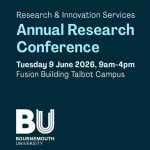 BU Annual Research Conference: Poster Exhibition Call for Applications
 Vitae Three Minute Thesis (3MT®) Competition: Applications Now Open
 3C Online Social: Thursday 26 March 1–2pm – Research Culture, Community & Can you Guess Who?
 Four BU students at national midwifery conference
 ECR Funding Open Call: Research Culture & Community Grant – Apply now
 ECR Funding Open Call: Research Culture & Community Grant – Application Deadline Friday 12 December
 MSCA Postdoctoral Fellowships 2025 Call
 ERC Advanced Grant 2025 Webinar
 Update on UKRO services
 European research project exploring use of ‘virtual twins’ to better manage metabolic associated fatty liver disease