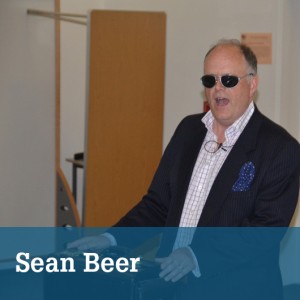
Name, position and Faculty
Dr Sean Beer, Senior Academic, Faculty of Management.
What part of the student engagement programme did you take part in?
14: Live.
Was it a good platform to promote your research with, if so then why was it?
It was an interesting platform, in that it is quite a different venue, doing a presentation in what is in effect a refractory. So the form of delivery has to be engaging. If you can make a connection then I think that it is a good opportunity. Though you need to make it memorable and it would be interesting to know what people really took away from it.
What advice would you give an academic seeking to engage students in their research?
If you are going to do an event of this type go to a session when someone else is presenting so that you can take in the venue.
In general deploy Ashcroft’s determinants of learning:
- Ensure objectives are understood
- Ensure objectives are relevant
- Arouse the learner
- Provide useful feedback
- Reward learning
- Provide multiple examples
- Actively involve learners
- Use a range of senses
- Eliminate distracters
- Provide a positive learning climate
These are the guiding principles that have helped me, help others learn over a period of 30 years. They are genius and they can be utilized in any situation.







 Three CMWH presentations at Berlin conference
 New interdisciplinary paper on Nepal
 National Postdoc Appreciation Week 2026: The Changing Landscape of Postdoc Careers
 NIHR Insight South West Central Conference 2026 at Bournemouth University
 Horizon Europe Cluster 3 (Civil Security for Society) 2026 Calls Now Open
 MSCA Doctoral Networks 2026 Call Information Webinar
 ESRC Festival of Social Science 2026: Application Deadline Extended to Thursday 25 June 2026
 Reminder: Register for the ESRC Festival of Social Science 2026 Information Session
 ECR Funding Open Call: Research Culture & Community Grant – Apply now
 ERC Advanced Grant 2025 Webinar
 Update on UKRO services
 European research project exploring use of ‘virtual twins’ to better manage metabolic associated fatty liver disease