I have taught at Université Paris Ouest Nanterre La Défense on a number of occasions but I continue to be impressed by the enthusiasm and challenging questions the Master’s level students pose. Paris is rich with culture and the education system has many benefits. I am privileged to be part of a growing French research culture that respects skills and knowledge with cutting edge technology in neuroscience.

Sacre Coeur, roof-top; Gare du Nord, r.

Eiffel Tower, roof-top.
This complements my experience at Bournemouth University and has enabled me to collaborate on projects that face difficult challenges with respect to ethics and use of expensive technology, namely fMRI scanning. Functional Magnetic Resonance Scanning is notoriously expensive yet the benefits to clinical research are potentially huge.
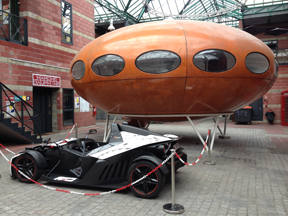
Modernism - or the Aliens have landed!
My study on yawning and cortisol at Bournemouth University [1] has now includes collaboration with three prestigious centres in France: Université Paris Ouest Nanterre La Défense, Amiens University Hospital, University of Picardy Jules Verne.
I hope to continue my Anglo-French meetings with the assistance of the Erasmus Travel Scholarship scheme in the future, as well as with funding from the French Embassy and the French Multiple Sclerosis Society.
[1] Thompson, S.B.N., 2014. Yawning, fatigue and cortisol: expanding the Thompson Cortisol Hypothesis. Medical Hypotheses. Doi: 10.1016/j.mehy.2014.08.009.







 SONAMONI contributions to Safety Conference 2026 in South Africa
 Three CMWH presentations at Berlin conference
 New interdisciplinary paper on Nepal
 Horizon Europe Cluster 3 (Civil Security for Society) 2026 Calls Now Open
 MSCA Doctoral Networks 2026 Call Information Webinar
 ESRC Festival of Social Science 2026: Application Deadline Extended to Thursday 25 June 2026
 Reminder: Register for the ESRC Festival of Social Science 2026 Information Session
 ECR Funding Open Call: Research Culture & Community Grant – Apply now
 ERC Advanced Grant 2025 Webinar
 Update on UKRO services
 European research project exploring use of ‘virtual twins’ to better manage metabolic associated fatty liver disease