It has been a busy month for researchers in the Centre for Midwifery and Women’s Health. Academics have been reporting their findings on improving care and support for women in early / latent phase labour.
This has included a specially focused issue in Women and Birth edited by Professors Susanne Grylka-Baeschlin and Vanora Hundley.
The issue starts with an editorial by Grylka-Baeschlin S, Hundley V, Cheyne H et al (2023) Early labour: an under-recognised opportunity for improving the experiences of women, families and maternity professionals Women & Birth https://doi.org/10.1016/j.wombi.2023.09.004
The issue includes the results of a randomised controlled trial by CMWH member Dr Rebecca Edwards:
Edwards R, Way S and Hundley V (2023) Let’s Talk Early Labour: The L-TEL Randomised Controlled Trial. Women & Birth https://doi.org/10.1016/j.wombi.2023.07.132 
and the results of the BALL trial by midwifery lecturer Dr Dominique Mylod:
Mylod DC, Hundley V, Way S, Clark C (2023) Can a birth ball reduce pain perception for women at low obstetric risk in the latent phase of labour? The Ball Assisted Latent Labour (BALL) randomised controlled trial. Women & Birth https://doi.org/10.1016/j.wombi.2023.11.008
An additional paper by doctoral student Vanessa Bartholomew has just been published in Sexual & Reproductive Healthcare:
 Bartholomew V, Hundley V, Clark C, Parris B (2024) The RETHINK Study: Could pain catastrophisation explain why some women are more likely to attend hospital in early labour. Sexual & Reproductive Healthcare https://doi.org/10.1016/j.srhc.2023.100941







 Verbal autopsy paper published two days ago
 ESRC Studentships for 2027 Entry: Opportunity Now Open
 SONAMONI contributions to Safety Conference 2026 in South Africa
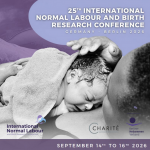 Three CMWH presentations at Berlin conference
 Horizon Europe Cluster 3 (Civil Security for Society) 2026 Calls Now Open
 MSCA Doctoral Networks 2026 Call Information Webinar
 ESRC Festival of Social Science 2026: Application Deadline Extended to Thursday 25 June 2026
 Reminder: Register for the ESRC Festival of Social Science 2026 Information Session
 ECR Funding Open Call: Research Culture & Community Grant – Apply now
 ERC Advanced Grant 2025 Webinar
 Update on UKRO services
 European research project exploring use of ‘virtual twins’ to better manage metabolic associated fatty liver disease