The Nepal-based Dhaulagiri Journal of Sociology and Anthropology published its latest issue today, the last day of 2024, with an editorial on the hot topic of ‘The Use of Artificial Intelligence (AI) in Academic Writing and Publishing Papers’ [1].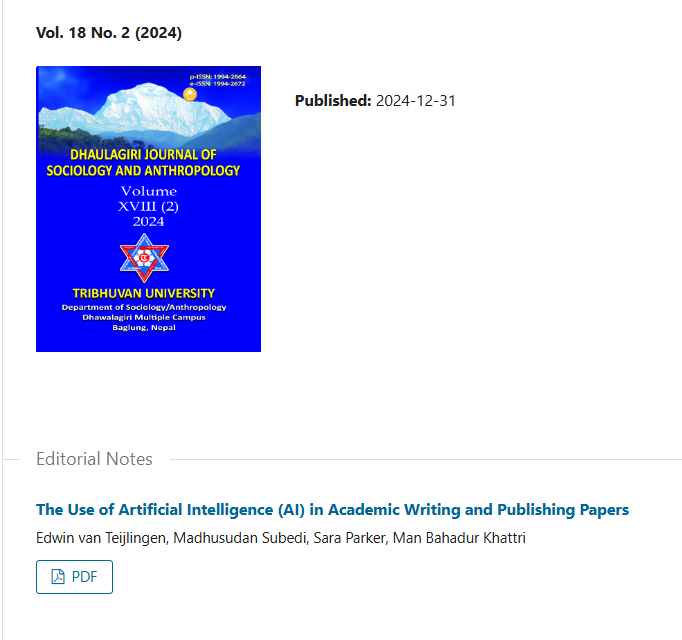
In this editorial, the authors made it very clear that the complete text in Box 1 is generated by AI. Which is appropriate considering the focus of this editorial is on questions raised by the potential use of academic writing. The authors argue that AI should be used with consideration to avoid misuse. Any use of AI should be done transparently, ethically, and professionally, and the authors should take full responsibility for the accuracy of the information.
Prof. Edwin an Teijlingen
Centre for Midwifery & Women’s Health
Reference:
-
van Teijlingen, E., Subedi, M., Parker, S., Khattri, M.B. (2024) The Use of Artificial Intelligence (AI) in Academic Writing and Publishing Papers Dhaulagiri Journal of Sociology & Anthropology, 18(2): 1-4. https://www.nepjol.info/index.php/DSAJ/article/view/73358
 Positionality in qualitative research
 Latest BU publication on academic writing
 Interview with BU professor published
 New BU publication on academic writing







 NIHR Insight South West Central Conference 2026 at Bournemouth University
 BU PhD student presented at World Drowning Prevention Conference in South Africa
 National Research Supervision Recognition: Apply Now & Join the Supporting Workshop on 16 September
 3C Event: ECR Network Café – Wednesday 16 September 2-3pm
 BU geography student’s undergraduate dissertation published in international journal
 Horizon Europe Cluster 3 (Civil Security for Society) 2026 Calls Now Open
 MSCA Doctoral Networks 2026 Call Information Webinar
 ESRC Festival of Social Science 2026: Application Deadline Extended to Thursday 25 June 2026
 Reminder: Register for the ESRC Festival of Social Science 2026 Information Session
 ECR Funding Open Call: Research Culture & Community Grant – Apply now
 ERC Advanced Grant 2025 Webinar
 Update on UKRO services
 European research project exploring use of ‘virtual twins’ to better manage metabolic associated fatty liver disease