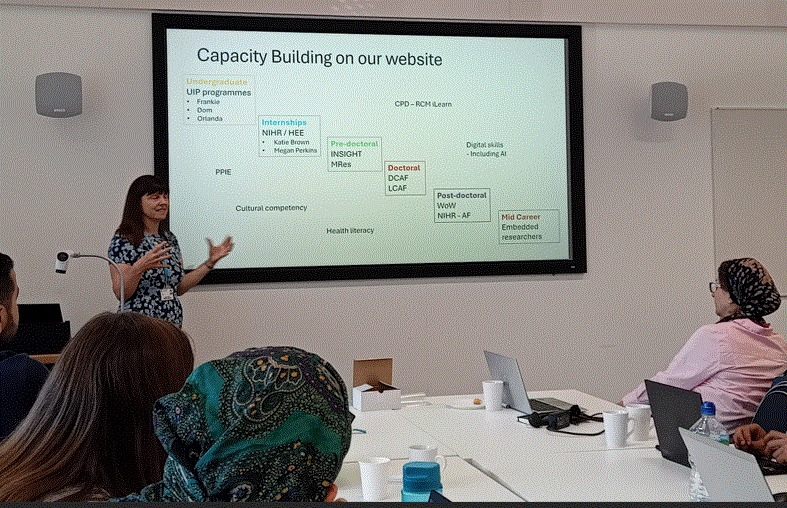
 Today was the first day of strategic planning for the MIHERC project. Our collaborators from Sheffield and Doncaster came down to Bournemouth University to discuss progress, meet with midwifery practitioners from University Hospital Dorset NHS Foundation Trust,
 and plan action for the coming year.
  MIHERC comprises an interdisciplinary team, led by Prof. Hora Soltani at Sheffield Hallam University, which has members from ethnically and professionally diverse colleagues from Sheffield Hallam University, Bournemouth University and Doncaster City Council.
Professors Vanora Hundley and Edwin van Teijlingen from the Centre for Midwifery and Women’s Health (CMWH), and Prof. Huseyin Dogan and Dr. Deniz Cetinkaya from the Department of Computing and Informatics are the key Bournemouth University applicants in MIHERC (Maternal & Infant Health Equity Research Centre). Further Bournemouth University academics have been incorporated since its start, these include: Drs. Malika Felton, Orlanda Harvey, Dominique Mylod and Daisy Wiggins. MIHERC is one of the nine NIHR-funded groups to tackle inequalities in UK maternal healthcare as part of the NIHR Challenge Call: Maternity Disparities Consortium. We are proud that of the nine funded groupings across the UK, MIHERC is the only one that is midwifery led.
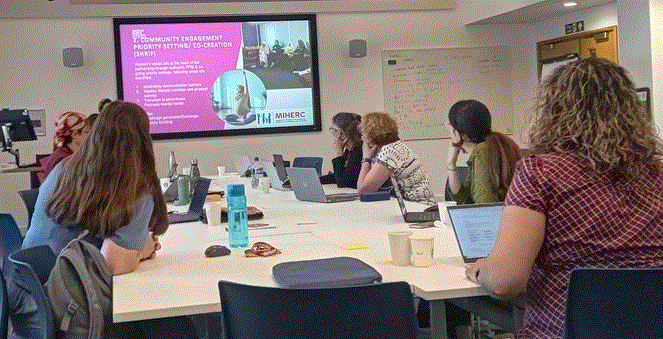
 Meeting at BU to address maternal inequalities
 NIHR-funded research launches website
 Bournemouth University eHealth paper cited 40 times!







 SONAMONI contributions to Safety Conference 2026 in South Africa
 Three CMWH presentations at Berlin conference
 New interdisciplinary paper on Nepal
 Horizon Europe Cluster 3 (Civil Security for Society) 2026 Calls Now Open
 MSCA Doctoral Networks 2026 Call Information Webinar
 ESRC Festival of Social Science 2026: Application Deadline Extended to Thursday 25 June 2026
 Reminder: Register for the ESRC Festival of Social Science 2026 Information Session
 ECR Funding Open Call: Research Culture & Community Grant – Apply now
 ERC Advanced Grant 2025 Webinar
 Update on UKRO services
 European research project exploring use of ‘virtual twins’ to better manage metabolic associated fatty liver disease