Congratulations to the interdisciplinary BU team on the publication of the paper ‘Up2U: designing and validating a new evidence-based programme for perpetrators of domestic abuse who want to change’ in Frontiers in Psychology [1]. The new paper is part of the series ‘The Dynamics of Emotion Regulation and Aggressiveness in Gender-Based Violence Contexts’, and it appeared in an Open Access journal and is therefore easily accessible.
Domestic abuse is a pervasive issue rooted in patterns of power and control, contributing to a significant number of high-harm offenses both in the UK and internationally. While programmes have been aiming to disrupt abusive cycles through the understanding and recognition of harm, there is widespread disagreement on what effective interventions should look like. This paper addresses this gap.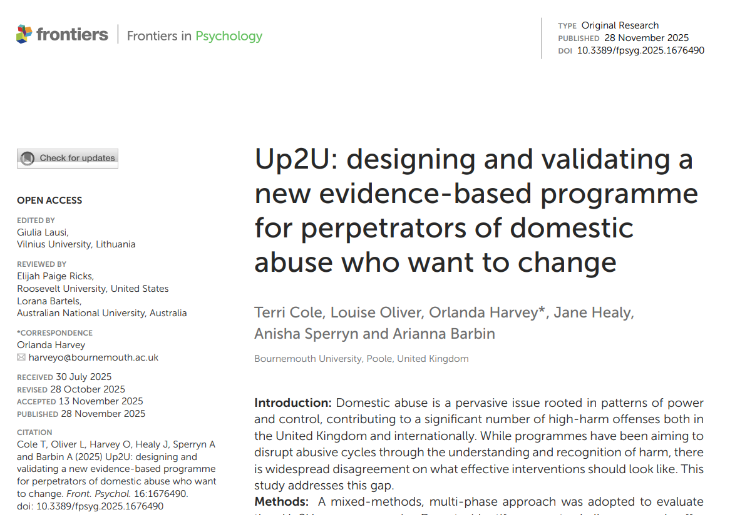
The authors of this paper include both psychologists and social workers, as well as a student co-author. The lead author, Terri Cole, is a Principal Academic in Forensic Psychology.
Congratulations!
Prof. Edwin van Teijlingen
Reference:
- Cole, T., Oliver, L., Harvey, O., Healy, J., Sperryn, A., Barbin, A. (2025) Up2U: designing and validating a new evidence-based programme for perpetrators of domestic abuse who want to change, Frontiers in Psychology, Volume 16 – 28 Nov.2025 | https://doi.org/10.3389/fpsyg.2025.1676490
 Congratulation on new interdisciplinary publication
 New BU publication on academic writing
 New BU social sciences and social work publication







 New HIV paper by BU PhD student
 BU Annual Research Conference: Poster Exhibition Call for Applications
 Vitae Three Minute Thesis (3MT®) Competition: Applications Now Open
 3C Online Social: Thursday 26 March 1–2pm – Research Culture, Community & Can you Guess Who?
 Four BU students at national midwifery conference
 ECR Funding Open Call: Research Culture & Community Grant – Apply now
 ECR Funding Open Call: Research Culture & Community Grant – Application Deadline Friday 12 December
 MSCA Postdoctoral Fellowships 2025 Call
 ERC Advanced Grant 2025 Webinar
 Update on UKRO services
 European research project exploring use of ‘virtual twins’ to better manage metabolic associated fatty liver disease