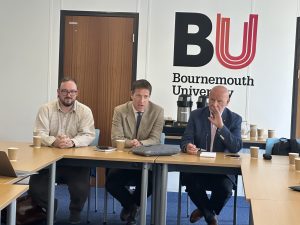
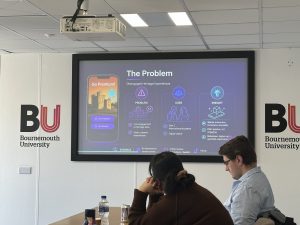
There are milestone moments in teaching that expose, quite starkly, what higher education can be when it stops playing safe. Watching our MBA students present their venture proposals to members of the Turing Centre Steering Group today was one of those moments—not just because the work was strong, but because it was earned under very different conditions from the norm.
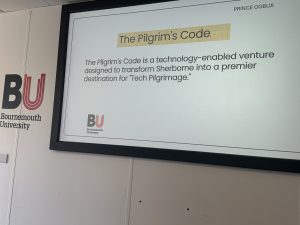
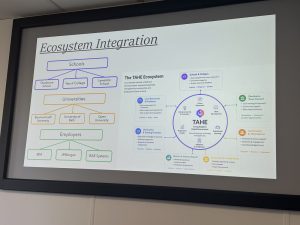
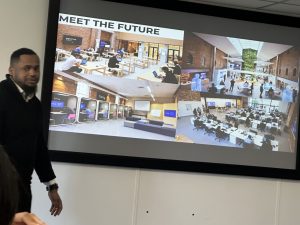
This was not the endpoint of a lecture-led module or a polished case discussion. It began with disruption. In late February, students travelled to Sherborne, Dorset, to work directly with the emerging Turing Centre: a civic initiative built around digital skills, regional regeneration, and long-term social value. What they encountered was not a finished project, but one still taking shape—messy, incomplete, and marked by competing priorities. That difference matters. Much of management education still relies on a quiet fiction: that complex organisational problems can be stabilised, analysed, and resolved within the controlled environment of a classroom. Ghoshal (2005) warned that such abstractions risk distorting managerial reality, while Mintzberg (2004) argued that MBA programmes often produce graduates more comfortable analysing than acting. Two decades on, that critique has not gone away. If anything, it has sharpened, with business schools still accused of privileging abstracted managerialism over embedded, socially situated practice (Parker, 2021).
Entrepreneurship education has attempted to respond. The shift towards “entrepreneurship as method” (Neck and Corbett, 2018) and the rise of experiential pedagogies (Hägg and Gabrielsson, 2020) reflect a recognition that uncertainty cannot be taught through tidy models alone. But this shift has its own problem. Experience, on its own, is not a pedagogy. As Nabi et al. (2017) show, the impact of entrepreneurship education is uneven, and often superficial, when activity is not matched by intellectual depth.
The question, then, is not whether students should engage with the real world, but how. The Sherborne project was designed around a simple but demanding premise: immersion should generate inquiry, not replace it. Students entered a live civic initiative and were asked to make sense of it—not retrospectively, but in real time. This required a different kind of thinking: one that is situated, provisional, and responsive to unfolding conditions (Sandberg and Tsoukas, 2011).
Sarasvathy’s (2001) concept of effectuation captures this well. Entrepreneurs do not begin with fixed goals and optimal strategies; they begin with what they have, act under uncertainty, and construct opportunity through iteration. That is exactly the position our students found themselves in. There was no stable problem definition, no guaranteed feasibility—only the expectation that they would build defensible arguments from ambiguity.
This is where the implications for MBA education become harder to ignore. If the degree is to remain credible, it cannot continue to prioritise analysis detached from consequence. Civic immersion offers a direct challenge by relocating learning into place-based contexts where decisions carry visible implications—not just for a grade, but for people, projects, and communities (Goddard et al., 2016; Parker, 2020).
But this only works if the academic design holds its nerve. The unit—Entrepreneurship: Technology-Driven Ventures and User-Centred Business Solutions—was structured so that experience functioned as the beginning of rigorous work, not its substitute. Students were required to identify user-centred problems, engage with wider civic and economic considerations, and develop proposals capable of withstanding external scrutiny. This aligns with principles of authentic assessment (Villarroel et al., 2018), but more importantly with the growing emphasis on evaluative judgement—the capacity to make and justify quality decisions in uncertain contexts ( Ajjawi et al., 2018).
The assessment environment itself mattered. Members of the Turing Centre Steering Group were present throughout—questioning assumptions, testing logic, and engaging seriously with the students’ ideas. This was not performative real-world exposure. It was accountability. The students’ work had an audience beyond the university, and that changed the level of intellectual seriousness in the room.
Students moved more confidently between theory and context, using frameworks not as templates, but as tools. This is much closer to Schön’s (1983) reflective practitioner: someone who thinks within action, not just about it. It is also where many experiential approaches fall short. Kolb’s (1984) model is often reduced to a cycle of activity, with reflection treated as an afterthought. As Kayes (2017) and Morris (2020) argue, this risks producing busyness rather than insight. Well-designed civic immersion does the opposite. It makes thinking harder, not easier.
Pittaway and Cope (2007) describe entrepreneurship education as requiring “disorienting dilemmas.” The Sherborne project delivered exactly that. The Turing Centre resisted neat categorisation—part innovation hub, part educational initiative, part regional strategy. Students could not rely on familiar models without adapting them. They had to engage in sensemaking that was negotiated, incomplete, and contingent (Sandberg and Tsoukas, 2011).
Unsurprisingly, a few of them described the experience as the most valuable part of their student journey. That response is telling. Students are rarely fooled by surface-level “real-world” tasks. What they recognised here was something more demanding: work that required judgement, carried risk, and had consequences beyond assessment. Learning deepens when students create value outside the classroom, not just simulate it within ( Lackéus, 2020).
This raises a question for management education. If the most meaningful learning happens under these conditions, why are they still the exception rather than the norm? Civic immersion is not easy. It requires partnerships, careful design, and a willingness to relinquish some control over the learning process. But it also exposes a deeper issue: that many MBA programmes remain structured around environments that minimise uncertainty precisely when they should be engaging with it.
When students are trusted with complexity—and held to high intellectual standards within it, learning becomes less about mastering frameworks and more about using them under pressure. Less about arriving at answers, and more about making defensible decisions when answers are not obvious. That is not a softer form of education. It is a more demanding one.
Ajjawi, R., Tai, J., Dawson, P., & Boud, D. (2018). Conceptualising evaluative judgement for sustainable assessment in higher education. In D. Boud, R. Ajjawi, P. Dawson, & J. Tai (Eds.), Developing evaluative judgement in higher education: Assessment for knowing and producing quality work (1st ed., pp. 7-17). Routledge. https://doi.org/10.4324_9781315109251-2.
Ghoshal, S. (2017). Bad management theories are destroying good management practices. Academy of Management Learning & Education, 4(1), 75–91. https://doi.org/10.5465/amle.2005.16132558
Goddard, J., Hazelkorn, E., Kempton, L., & Vallance, P. (2016). The civic university: The policy and leadership challenges. Edward Elgar Publishing. https://doi.org/10.4337/9781784717728
Hägg, G., & Gabrielsson, J. (2020). A systematic literature review of the evolution of pedagogy in entrepreneurial education research. International Journal of Entrepreneurial Behavior & Research, 26(5), 829–861. https://doi.org/10.1108/IJEBR-04-2018-0272
Kayes, D. C. (2017). Experiential learning and its critics: Preserving the role of experience in management learning and education. Academy of Management Learning & Education, 1(2), 137–149. https://doi.org/10.5465/amle.2002.8509336
Kolb, D. A. (1984). Experiential learning: Experience as the source of learning and development. Prentice-Hall.
Lackéus M (2020). Comparing the impact of three different experiential approaches to entrepreneurship in education. International Journal of Entrepreneurial Behavior & Research, 26(5), pp. 937–971. https://doi.org/10.1108/IJEBR-04-2018-0236
Mintzberg, H. (2004). Managers not MBAs: A hard look at the soft practice of managing and management development. Berrett-Koehler.
Morris, T. H. (2020). Experiential learning – a systematic review and revision of Kolb’s model. Interactive Learning Environments, 28(8), 1064–1077. https://doi.org/10.1080/10494820.2019.1570279
Nabi, G., Liñán, F., Fayolle, A., Krueger, N., & Walmsley, A. (2017). The impact of entrepreneurship education in higher education: A systematic review and research agenda. Academy of Management Learning & Education, 16(2), 277–299. https://doi.org/10.5465/amle.2015.0026
Neck, H. M., & Corbett, A. C. (2018). The scholarship of teaching and learning entrepreneurship. Entrepreneurship Education and Pedagogy, 1(1), 8–41. https://doi.org/10.1177/2515127417737286
Parker, M. (2020). The Critical Business School and the University: A Case Study of Resistance and Co-optation. Critical Sociology. 47. 089692052095038. 10.1177/0896920520950387.
Pittaway, L., & Cope, J. (2007). Entrepreneurship education: A systematic review of the evidence. International Small Business Journal, 25(5), 479–510. https://doi.org/10.1177/0266242607080656
Sandberg, J., & Tsoukas, H. (2011). Grasping the logic of practice: Theorizing through practical rationality. Academy of Management Review, 36(2), 338–360. https://doi.org/10.5465/AMR.2009.0183
Sarasvathy, S. D. (2001). Causation and Effectuation: Toward a Theoretical Shift from Economic Inevitability to Entrepreneurial Contingency. The Academy of Management Review, 26(2), 243–263. https://doi.org/10.2307/259121
Schön, D. A. (1983). The reflective practitioner: How professionals think in action. Basic Books.
Villarroel, V., Bloxham, S., Bruna, D., Bruna, C., & Herrera-Seda, C. (2018). Authentic assessment: Creating a blueprint for course design. Assessment & Evaluation in Higher Education, 43(5), 840–854. https://doi.org/10.1080/02602938.2017.1412396
 Cafe Scientifique: How can Virtual Reality be used to support our students’ learning?







 ECR Opportunities: New Development Programme, Research Grants & Upcoming Events
 Help us capture BU’s knowledge exchange activity HE-BCI survey 2025–26
 Verbal autopsy paper published two days ago
 ESRC Studentships for 2027 Entry: Opportunity Now Open
 SONAMONI contributions to Safety Conference 2026 in South Africa
 Horizon Europe Cluster 3 (Civil Security for Society) 2026 Calls Now Open
 MSCA Doctoral Networks 2026 Call Information Webinar
 ESRC Festival of Social Science 2026: Application Deadline Extended to Thursday 25 June 2026
 Reminder: Register for the ESRC Festival of Social Science 2026 Information Session
 ECR Funding Open Call: Research Culture & Community Grant – Apply now
 ERC Advanced Grant 2025 Webinar
 Update on UKRO services
 European research project exploring use of ‘virtual twins’ to better manage metabolic associated fatty liver disease