Reflections from a Research Seminar with Mark Frydenberg
By Debbie Holey, Emerita Professor HEMS and Dr Rowena Slope with contributions from colleagues at Bournemouth University and Bentley University
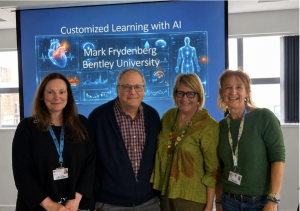
Pictured L-R Dr Rowena Slope, (Senior Lecturer in Adult Nursing and research lead for AI in healthcare); Mark Frydenberg, Distinguished Lecturer and Director of the CIS Learning and Technology Sandbox, Berkeley University, USA; Debbie Holey, Emerita Professor HEMS, and Lucy Stainer, Senior Lecturer in Adult Nursing and doctoral student.
Artificial Intelligence (AI) is increasingly reshaping healthcare education, clinical practice, and professional learning, prompting important questions about how future nurses and healthcare professionals should be prepared for digitally enhanced environments. These themes formed the focus of a recent interdisciplinary research seminar led by Mark Frydenberg from Bentley University, USA; a distinguished lecturer, educator and technology scholar from Massachusetts, USA whose work explores innovative approaches to teaching and learning with emerging technologies. Contributions from Matt Jarvis, Bournemouth University learning technologist, Debbie Holley, Emerita Professor of Learning Innovation (HEMS) further highlighted how AI is beginning to influence nursing education, digital pedagogy, and healthcare innovation across higher education.
A central theme throughout the seminar was the growing importance of AI literacy within nursing and healthcare curricula. While students may appear highly confident using digital technologies, research by Frydenberg and colleagues suggests that technological confidence does not necessarily equate to deeper digital and data literacy skills. As generative AI tools become more widely adopted in higher education and healthcare, students must develop the ability to critically evaluate AI-generated information, understand ethical implications, recognise algorithmic bias, and maintain evidence-based decision-making. These discussions align closely with the UNESCO framework outlined in Reimagining Our Futures Together (2021), which advocates for active, participatory learning and learner agency within rapidly evolving educational environments.
The seminar also explored practical applications of AI within healthcare education and clinical practice, including AI-supported simulation, personalised learning pathways, administrative support, predictive analytics, and clinical decision-support systems. While these technologies may enhance efficiency, responsiveness, and access to information, participants emphasised that AI should support rather than replace professional judgement, compassionate care, and human interaction. Nursing practice remains fundamentally relational, requiring empathy, communication, and ethical reasoning that cannot be fully replicated through automated systems.
Alongside opportunities, the discussions acknowledged significant ethical and pedagogical challenges associated with AI adoption in healthcare and higher education. Concerns included data privacy, transparency in algorithmic decision-making, unequal access to technology, and the potential erosion of independent critical thinking through over-reliance on AI-generated outputs. Participants reflected on the importance of designing learning environments that encourage students to engage critically with AI tools rather than passively accepting generated information. Collaborative discussion activities during the seminar encouraged attendees to map future interdisciplinary projects and implementation strategies that place ethical, human-centred practice at the core of AI innovation.
Overall, the seminar highlighted that AI presents not only a technological shift, but also an opportunity to rethink healthcare education, learner engagement, and professional preparation. As healthcare systems continue integrating intelligent technologies, educators and researchers have a responsibility to ensure that future nurses are equipped with the critical, ethical, and reflective skills necessary to work effectively within digitally enhanced clinical environments. The discussions reinforced the importance of interdisciplinary collaboration, responsible innovation, and maintaining the core values of healthcare practice as institutions navigate this rapidly evolving landscape.
References
Advance HE (2026) Pre-arrival questionnaire (PAQ) national pilot wave 1 initial results. Available at: https://advance-he.ac.uk/knowledge-hub/pre-arrival-questionnaire-national-pilot-wave-one-initial-results
Dickinson, J. and Marshall, M. (2026) ‘Trained to stop learning: How students are experiencing assessment and learning in an age of AI’, Wonkhe, 23 March.
Frydenberg, M., Mentzer, K. and Patterson, A. (2026) ‘The rapid rise of generative AI adoption among first-year college students’, Information Systems Education Journal, 24(1).
Frydenberg, M.E. (2024) ‘Are tech savvy students tech literate? Digital and data literacy skills of first-year college students’, Information Systems Education Journal, 22(3).
NHS England (2022) AI in health and care: a report from the NHS AI Lab.
Stephenson, R. and Armstrong, C. (2026) Student generative artificial intelligence survey 2026 (HEPI Report 199). Higher Education Policy Institute.
UNESCO (2021) Reimagining Our Futures Together: A New Social Contract for Education.
World Health Organization Europe (2026) New WHO Europe report provides first-ever snapshot of AI in health care across European Union member states.







 Verbal autopsy paper published two days ago
 ESRC Studentships for 2027 Entry: Opportunity Now Open
 SONAMONI contributions to Safety Conference 2026 in South Africa
 Three CMWH presentations at Berlin conference
 Horizon Europe Cluster 3 (Civil Security for Society) 2026 Calls Now Open
 MSCA Doctoral Networks 2026 Call Information Webinar
 ESRC Festival of Social Science 2026: Application Deadline Extended to Thursday 25 June 2026
 Reminder: Register for the ESRC Festival of Social Science 2026 Information Session
 ECR Funding Open Call: Research Culture & Community Grant – Apply now
 ERC Advanced Grant 2025 Webinar
 Update on UKRO services
 European research project exploring use of ‘virtual twins’ to better manage metabolic associated fatty liver disease