In January 2026, Dr. Paul Whittington was invited to be a panellist on the Department for Education (DfE) Assistive Technology roundtable at Bett 2026 in ExCel London, the leading event for education technology. The purpose of the roundtable was for DfE policy colleagues to listen and learn from domain experts in assistive technology to further inform their understanding of the use of assistive technology in mainstream education. There were two focused areas for discussion, ‘barriers and enablers to assistive technology in mainstream settings’ and ‘the existing evidence base’.
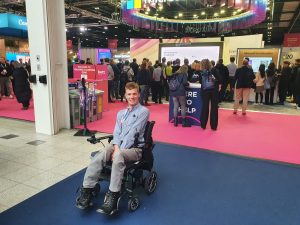
The roundtable was chaired by Helen Davies, Assistive Technology Policy Lead at DfE and included panellists from the University of Dundee and CENMAC, a London based advisory service providing assessments of assistive technology. Interesting discussions were held during the one hour panel session where the current challenges of assistive technology in education were highlighted. This included that pupils with disabilities are often unaware of the technologies that can support them with education and that teachers/support staff may not have the required knowledge to guide the individuals. Dr. Paul Whittington emphasised his personal experience of the importance that assistive technology played in his mainstream education, in terms of accessing computers and educational resources. A theme of a discussion was developing recommendation systems for assistive technology and how this could aim to improve awareness of available products, which is aligned closely with the EduAbility application developed by Dr. Paul Whittington and Professor Huseyin Dogan from the Department of Computing and Engineering.
Attending the roundtable was also an opportunity to visit the many exhibitors at Bett 2026 who were showcasing the latest in innovations in assistive technology as well as other products for general educational use. Exhibitors included suppliers of software such as Crick Software, VisionAid and The Williams AV Family of Assistive Communication Solutions. There were also some interesting robotics technologies that have been designed to provide practical support for people with disabilities.
Visiting the exhibitors was an opportunity to introduce EduAbiity as a method for manufacturers to promote their products to potential customers. The British Association for Assistive Technology (BATA) had a stand at the show and discussions were held in relation to Bournemouth University becoming an academic member of the association to further our future research in the domain in terms of conducting evaluations and maximising visibility of our initiatives in line with the BU 2035 research strategy.
Overall, it was a very valuable visit to the Bett 2026 show in terms of contributing to DfE discussions and promoting our assistive technology research. We are currently in the process of developing the EduAbility application for iOS and once this is publicly disseminated through the Apple Store and Google Play Store, there could be potential for Bournemouth University to attend the Bett Show as an exhibitor in the future.
 Dr. Paul Whittington attends Technology and the SEND Reforms Roundtable in the House of Commons
 Recent Assistive Technology Public Engagement Events
 Assistive Technology Symposium 2019
 Assistive Technology Symposium 2019







 ECR Opportunities: New Development Programme, Researcher Grants & Upcoming Events
 Help us capture BU’s knowledge exchange activity HE-BCI survey 2025–26
 Verbal autopsy paper published two days ago
 ESRC Studentships for 2027 Entry: Opportunity Now Open
 SONAMONI contributions to Safety Conference 2026 in South Africa
 Horizon Europe Cluster 3 (Civil Security for Society) 2026 Calls Now Open
 MSCA Doctoral Networks 2026 Call Information Webinar
 ESRC Festival of Social Science 2026: Application Deadline Extended to Thursday 25 June 2026
 Reminder: Register for the ESRC Festival of Social Science 2026 Information Session
 ECR Funding Open Call: Research Culture & Community Grant – Apply now
 ERC Advanced Grant 2025 Webinar
 Update on UKRO services
 European research project exploring use of ‘virtual twins’ to better manage metabolic associated fatty liver disease