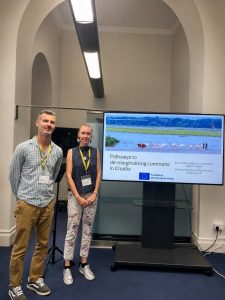
BU’s research presented at the Royal Geographical Society Annual Conference
Dr Marin Cvitanović, Principal Academic in Human Geography at BU’s School of Life and Environmental Sciences, presented research on commons at the Royal Geographical Society (with IBG) Annual International Conference, held at the Society and Imperial College London from 1 to 4 September 2026.
Commons are resources, such as pastures, forests and water, that are shared and managed collectively by a community, rather than owned privately or by the state. The presentation, “Pathways to de-marginalising commons in Croatia,” was co-authored with Dr Lana Slavuj Borčić of the University of Zagreb. It used Croatia as a case study to ask a question that is relevant well beyond one country: why do some shared-resource systems survive generations of political, economic and demographic change, while others quietly fall out of use? Cvitanović and Slavuj Borčić argue that commons can become marginalised in several ways at once. This includes geographical marginalisation in depopulating rural regions, institutional marginalisation through long periods of legal ambiguity, and economic marginalisation through exclusion from subsidies and leasing markets. A further, generational, form of marginalisation can also occur, where legal recognition arrives only after the community that once sustained a commons has already aged out of it.
To understand how some commons manage to persist despite these pressures, the researchers compared cases where common pastures had fallen out of use, with a case where a commons continued to function. The comparison points to a broader pattern. Legal recognition on its own rarely saves a commons. What tends to matter is whether governance support, funding routes and recognition of a resource’s wider ecological value arrive while a community of users still exists to make use of them. Even then, moving away from marginalisation looks more like an ongoing process than a finished achievement.
This work is linked to Dr Cvitanović’s involvement in Resilient Rules, an ERC-funded Horizon Europe project led by the University of Zaragoza, which studies the diversity and resilience of rules that communities worldwide use to govern shared natural resources. Dr Cvitanović contributes to the project’s global field research team, covering Croatia.
The RGS-IBG Annual International Conference is one of the world’s largest gatherings of geographers, bringing together more than 2,000 researchers each year. The 2026 conference theme, “Geographies of inequalities: towards just places,” was chaired by Professor Peter Hopkins of Newcastle University.







 International Open Access Week: BU support for open access
 Food Price Research Shortlisted for Civil Service Prize
 3C Event: Research Culture, Community & Connections – Wednesday 11 November 3-4pm
 ECR Opportunities: New Development Programme, Researcher Grants & Upcoming Events
 Help us capture BU’s knowledge exchange activity HE-BCI survey 2025–26
 Horizon Europe Cluster 3 (Civil Security for Society) 2026 Calls Now Open
 MSCA Doctoral Networks 2026 Call Information Webinar
 ESRC Festival of Social Science 2026: Application Deadline Extended to Thursday 25 June 2026
 Reminder: Register for the ESRC Festival of Social Science 2026 Information Session
 ECR Funding Open Call: Research Culture & Community Grant – Apply now
 ERC Advanced Grant 2025 Webinar
 Update on UKRO services
 European research project exploring use of ‘virtual twins’ to better manage metabolic associated fatty liver disease