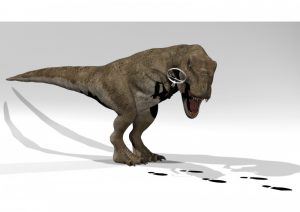
What do dinosaurs and the fossil footprints of our ancient human ancestors have to do with catching criminals?
Researchers at Bournemouth University have travelled the world over the last few years documenting fossil footprints both of humans and extinct animals. We read the story in the traces left in the rock record, to tell the story of how different animals interacted, how they walked and behaved. We have developed freeware to help capture these traces in 3D and analyse them using some cool mathematical techniques including machine learning. Recently we have shown how our American ancestors hunted giant ground sloth, and how patterns of human locomotion have changed as our ancestors in Africa evolved. Take this know-how, the mathematical tools and computer software we have developed to translate our research into forensic practice, and you have modern tools for the police to track criminals via their footprints.
Want to find out more? Come and see us at New Scientist Live 10-13 Oct 2019 ExCeL, London. Stand 524.
 New Research Collaboration between Bournemouth University and La Trobe University, Melbourne, Australia







 SONAMONI contributions to Safety Conference 2026 in South Africa
 Three CMWH presentations at Berlin conference
 New interdisciplinary paper on Nepal
 Horizon Europe Cluster 3 (Civil Security for Society) 2026 Calls Now Open
 MSCA Doctoral Networks 2026 Call Information Webinar
 ESRC Festival of Social Science 2026: Application Deadline Extended to Thursday 25 June 2026
 Reminder: Register for the ESRC Festival of Social Science 2026 Information Session
 ECR Funding Open Call: Research Culture & Community Grant – Apply now
 ERC Advanced Grant 2025 Webinar
 Update on UKRO services
 European research project exploring use of ‘virtual twins’ to better manage metabolic associated fatty liver disease