In light of the widespread use of populism by politicians across the world, BU academics Anastasia Veneti and Savvas Voutyras were interviewed by the Greek newspaper I Epohi on their research on political campaigning and populism.
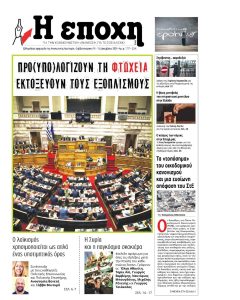 In the interview, the researchers explained that there is no single definition of populism. However, there is general consensus that populism comprises a view of politics as a fundamental antagonism between ‘the people’ and ‘the elites’, favouring the interests of the people.
Dr Voutyras argued that, in practice, it is anti-populists who define opponents as populists, regardless of whether they fit any definition. This initially seems to have some strategic advantages, since it categorises opponents as a singular problem and, in this sense, rallies supporters. In the long run, however, this tactic has facilitated the growth of the radical right. Parties that used to be labelled as neo-fascist, racist or authoritarian, have acquired new a label (i.e., ‘populist’) that is easier to manage.
Dr Veneti explained that there is a strand of studies that approach populism as a communication style. In such cases, the main dimensions of populist political actors’ communication are (a) people-centrism, (b) anti-elitism, (c) and reference to outgroups, and we can see these dimensions built in the political message both discursively and visually.
The whole interview can be found here.







 Verbal autopsy paper published two days ago
 ESRC Studentships for 2027 Entry: Opportunity Now Open
 SONAMONI contributions to Safety Conference 2026 in South Africa
 Three CMWH presentations at Berlin conference
 Horizon Europe Cluster 3 (Civil Security for Society) 2026 Calls Now Open
 MSCA Doctoral Networks 2026 Call Information Webinar
 ESRC Festival of Social Science 2026: Application Deadline Extended to Thursday 25 June 2026
 Reminder: Register for the ESRC Festival of Social Science 2026 Information Session
 ECR Funding Open Call: Research Culture & Community Grant – Apply now
 ERC Advanced Grant 2025 Webinar
 Update on UKRO services
 European research project exploring use of ‘virtual twins’ to better manage metabolic associated fatty liver disease