Researchers from Bournemouth University were honoured to attend the House of Commons on 23rd February for the parliamentary launch of Recover with Pride, the UK’s first dedicated LGBTQ+ gambling harm support programme.
Speaking on behalf of Bournemouth University’s Gambling Research Group, Dr Reece Bush-Evans shared research examining the barriers LGBTQIA+ people can face when seeking support for gambling-related harm. The presentation highlighted how minority stress, stigma, discrimination, and a lack of culturally competent provision can shape both experiences of harm and pathways to recovery. The key message was clear: this is not a niche issue — it is a public health and equality issue. Reece was joined by Professor John McAlaney, Head of the Gambling Research Group.
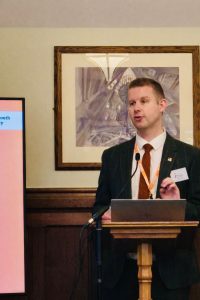

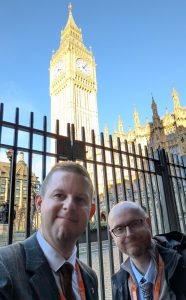
The Parliamentary event brought together over 40 representatives from across the sector and featured contributions from more than 10 organisations, including Brighton & Hove LGBT Switchboard, Ara Recovery For All, Gamstop, Gamban, Coalition to End Gambling Ads, Betknowmore UK, Cyrenians, Reframe Coaching, University of Brighton and EPIC Restart Foundation. The day also featured powerful lived experience testimonies and a keynote address from John Slinger MP. Representatives from organisations such as Stonewall Housing, LGBT Health and Wellbeing, The Primary Care Gambling Service, Galop, Adferiad, Chapter One and Beacon Counselling Trust were also in attendance, reflecting strong cross-sector commitment.
During the presentation, Reece discussed recently published peer-reviewed research exploring gambling harm within LGBTQIA+ communities, alongside the outputs of an International Conference and National Think Tank hosted by the Gambling Research Group in Bournemouth last November. Opened by Deputy Vice Chancellor and Provost Professor Niamh Downing, the conference brought together over 20 organisations spanning lived experience leaders, frontline services, researchers and policy stakeholders, with one clear purpose: to translate evidence into action.
Across a full day of international talks and collaborative discussion, several priorities were identified. Short-term actions included strengthening inclusive signalling across services, embedding consistent cultural competency training, and improving cross-sector collaboration and referral pathways. Longer-term goals focused on explicitly including LGBTQIA+ communities within national gambling strategies, establishing a national working group focused on marginalised communities, and developing sustainable LGBTQIA+-specific support networks.

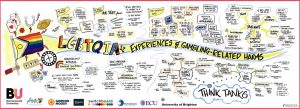
The energy in the room was captured by a live artist, visually recording discussions and commitments to change. Feedback from the November event was overwhelmingly positive: 94% of attendees reported that it significantly increased their understanding of gambling harms experienced by LGBTQIA+ communities, 89% said they were highly likely to implement change in their work, 83% reported a shift in their views or assumptions, and 100% developed new professional connections to support future action.
Taking place during LGBT History Month, the parliamentary launch of Recover with Pride represents more than a policy milestone. It reflects progress in recognising and addressing the specific challenges faced by LGBTQIA+ communities — ensuring that conversations about equality extend into emerging areas such as gambling harm. It is a proud moment for Bournemouth University and an important step forward in advancing inclusive, evidence-informed public health policy.







 Four BU students at national midwifery conference
 INRC book roundtable/presentation by Drs Jonathan Cole and Catherine Talbot, Wednesday 22/04/2026, 13:00h, P426
 BU M.Res. student’s evidence to UK Parliamentary Women & Equalities Committee
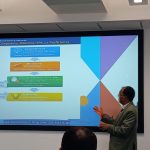 Prof Marahatta promoting BU-Nepal collaboration
 3C Online Social: Research Culture, Community & Can you Guess Who? Thursday 26 March 1-2pm
 ECR Funding Open Call: Research Culture & Community Grant – Apply now
 ECR Funding Open Call: Research Culture & Community Grant – Application Deadline Friday 12 December
 MSCA Postdoctoral Fellowships 2025 Call
 ERC Advanced Grant 2025 Webinar
 Update on UKRO services
 European research project exploring use of ‘virtual twins’ to better manage metabolic associated fatty liver disease