The Normal Labour and Birth Conference allowed me to experience a novel way of showcasing research and exchanging ideas – the PechaKucha. Pronounced “peh-chak-cha”, the PechaKucha session is made up of a series of short presentations. Presenters must use 20 slides, each of which must be displayed for exactly 20 seconds – no more, no less. The concept, conceived by two young architects (Astrid Klein and Mark Dytham) in Japan in 2003, is to enable individuals to exchange their ideas in a fast moving, concise and exciting format. Not one to ignore the call to try something new, I decided to undertake this challenge as a double act with my colleague Professor Helen Cheyne from the University of Stirling. We presented our team’s work on the media’s portrayal of labour and birth, which was also being displayed as a poster.
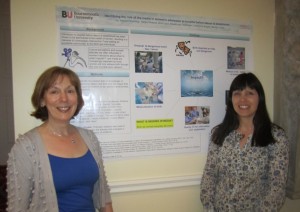
- Research team includes Ann Luce, Marilyn Cash, Vanora Hundley, Helen Cheyne, Edwin van Teijlingen and Catherine Angell
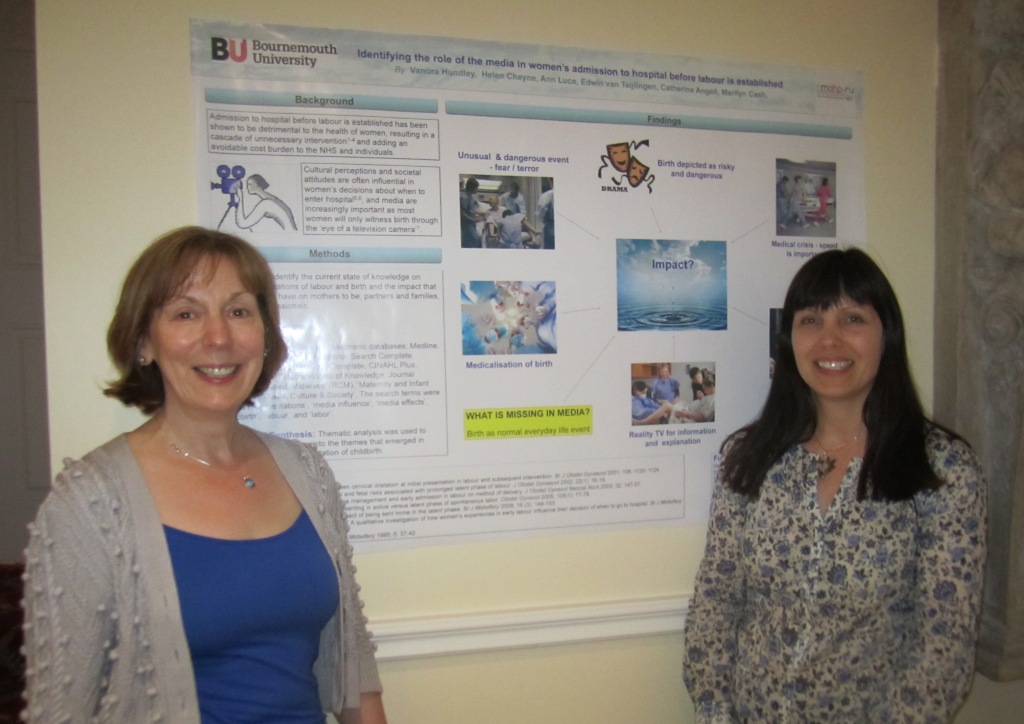
The PechaKucha was quite an undertaking, as the slides move automatically and you cannot stop them moving on! However, it really focused the mind and helped us identify the key messages from our work. The session was very lively and the energy generated a lot of discussion that continued into the coffee break afterwards. As for the PechaKucha method, I’d say that it is definitely a useful tool for our community research meetings, and perhaps also for our doctoral students to use as they prepare for their vivas.
The conference was also an opportunity to catch up with colleagues from the International Early Labour Research Group. The group have been involved in producing a series of research papers featured in a special issue of Midwifery. We also discussed future research and opportunities for research collaboration.







 Verbal autopsy paper published two days ago
 ESRC Studentships for 2027 Entry: Opportunity Now Open
 SONAMONI contributions to Safety Conference 2026 in South Africa
 Three CMWH presentations at Berlin conference
 Horizon Europe Cluster 3 (Civil Security for Society) 2026 Calls Now Open
 MSCA Doctoral Networks 2026 Call Information Webinar
 ESRC Festival of Social Science 2026: Application Deadline Extended to Thursday 25 June 2026
 Reminder: Register for the ESRC Festival of Social Science 2026 Information Session
 ECR Funding Open Call: Research Culture & Community Grant – Apply now
 ERC Advanced Grant 2025 Webinar
 Update on UKRO services
 European research project exploring use of ‘virtual twins’ to better manage metabolic associated fatty liver disease