Julie Kirkby and her team of PhD students delivered an interesting lecture combined with demonstrations for which the audience participated.
Using eye-tracking technology as ‘a window to the mind’, this allowed us to see the developmental differences of children with and without  dyslexia. It was interesting to know that when reading we only take in (fovea) around eight letters, whereas our peripheral vision (parafovea) can take in around 15 letters. There are also linguistic influences on our eye movements, such as how many letters, how often the word is read, and how much a word is expected. If comprehension breaks down then our eye movements are directed back to previously read text. Some, but not all, dyslexic people will have difficulty associating letters with speech sounds. Also, some will have ‘visual attention deficit’.
We had two demonstrations. The first was eye-linking to see where the eye looks when we’re reading. The second was the mobile (Dikablis) eye-tracker which demonstrates how we encode and produce information and how information can be forgotten in between. We were informed that it’s a myth that dyslexic children can’t copy from class boards. Reading ability affects the working memory and vice versa. There was a lot of great research shared and it was an engaging afternoon.
If you are interested in this then you may be interested in similar events going on tomorrow. These include Media literacy in secondary schools taking place at 12.30pm and Third space digital learning in Dorset schools taking place at 3.30pm.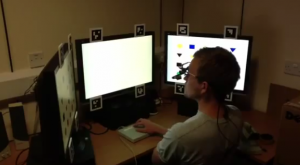







 NIHR Insight South West Central Conference 2026 at Bournemouth University
 BU PhD student presented at World Safety Conference in South Africa
 National Research Supervision Recognition: Apply Now & Join the Supporting Workshop on 16 September
 3C Event: ECR Network Café – Wednesday 16 September 2-3pm
 BU geography student’s undergraduate dissertation published in international journal
 Horizon Europe Cluster 3 (Civil Security for Society) 2026 Calls Now Open
 MSCA Doctoral Networks 2026 Call Information Webinar
 ESRC Festival of Social Science 2026: Application Deadline Extended to Thursday 25 June 2026
 Reminder: Register for the ESRC Festival of Social Science 2026 Information Session
 ECR Funding Open Call: Research Culture & Community Grant – Apply now
 ERC Advanced Grant 2025 Webinar
 Update on UKRO services
 European research project exploring use of ‘virtual twins’ to better manage metabolic associated fatty liver disease