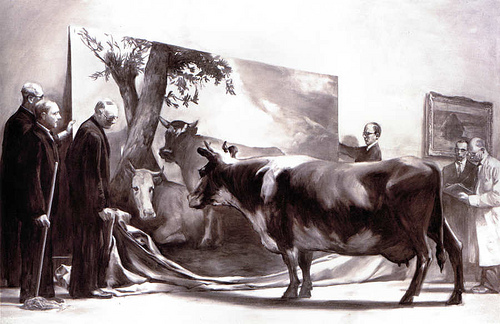
If we are going around an art gallery we are often aware that we are evaluating the aesthetic appeal of the artworks. What we may be less aware of is that when we are interacting with computers, websites, and applications on our mobile phones the aesthetic appeal of the interfaces we are using matters too. Appeal can make interfaces easier to use and certainly makes our interactions more enjoyable.
Angela Gosling and Siné McDougall (Psychology, Faculty of Science) recently received Fusion Funding to support a collaborative network with colleagues in at Fribourg in Switzerland and Swansea University to find out more about the role of aesthetic evaluations in human-computer interaction. We want to examine how we make decisions about the appeal and usability of an interface. These ‘decisions’ start when we unconsciously respond to interface appeal within the first few milliseconds that we encounter an interface and continue through to habitual everyday use. By investigating these processes we will develop a better understanding of how interface appeal influences user performance and lead to better interface optimisation. Our Fusion Funding is going to support our collaboration while we prepare grant proposals to take this work forward.







 ECR Opportunities: New Development Programme, Researcher Grants & Upcoming Events
 Help us capture BU’s knowledge exchange activity HE-BCI survey 2025–26
 Verbal autopsy paper published two days ago
 ESRC Studentships for 2027 Entry: Opportunity Now Open
 SONAMONI contributions to Safety Conference 2026 in South Africa
 Horizon Europe Cluster 3 (Civil Security for Society) 2026 Calls Now Open
 MSCA Doctoral Networks 2026 Call Information Webinar
 ESRC Festival of Social Science 2026: Application Deadline Extended to Thursday 25 June 2026
 Reminder: Register for the ESRC Festival of Social Science 2026 Information Session
 ECR Funding Open Call: Research Culture & Community Grant – Apply now
 ERC Advanced Grant 2025 Webinar
 Update on UKRO services
 European research project exploring use of ‘virtual twins’ to better manage metabolic associated fatty liver disease