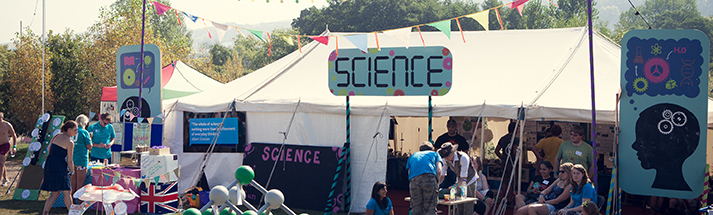
Before I first started this job the last thing I expected was to be going to one of biggest music festivals in the UK, but I couldn’t have been more wrong! I have been asked to join the team going to Bestival, where we will be showcasing some of the world class research happening at BU within the very popular science tent.
Being given the opportunity to showcase BU’s research at an event that sees more than 50,000 people through its gates, will be greatly beneficial towards the public/student engage of Bournemouth University.
The purpose of our activities will be to host a series of tests which will give the public a chance to test their physical and mental skills against those of the best athletes the U.K has to offer. These will include a Jump Mat test, which will test the participant’s stationary jumping power. The next activity is the T Wall Reaction test; this will test the participant’s reaction time as well as their memory. The last activity will be the running gate, this will test the participants running speed.
Please keep a close eye on the @BU_research twitter account to get the latest updates and news on what’s going on from the festival itself.







 International Open Access Week: open access and the REF
 Food Price Research Shortlisted for Civil Service Prize
 3C Event: Research Culture, Community & Connections – Wednesday 11 November 3-4pm
 ECR Opportunities: New Development Programme, Researcher Grants & Upcoming Events
 Horizon Europe Cluster 3 (Civil Security for Society) 2026 Calls Now Open
 MSCA Doctoral Networks 2026 Call Information Webinar
 ESRC Festival of Social Science 2026: Application Deadline Extended to Thursday 25 June 2026
 Reminder: Register for the ESRC Festival of Social Science 2026 Information Session
 ECR Funding Open Call: Research Culture & Community Grant – Apply now
 ERC Advanced Grant 2025 Webinar
 Update on UKRO services
 European research project exploring use of ‘virtual twins’ to better manage metabolic associated fatty liver disease