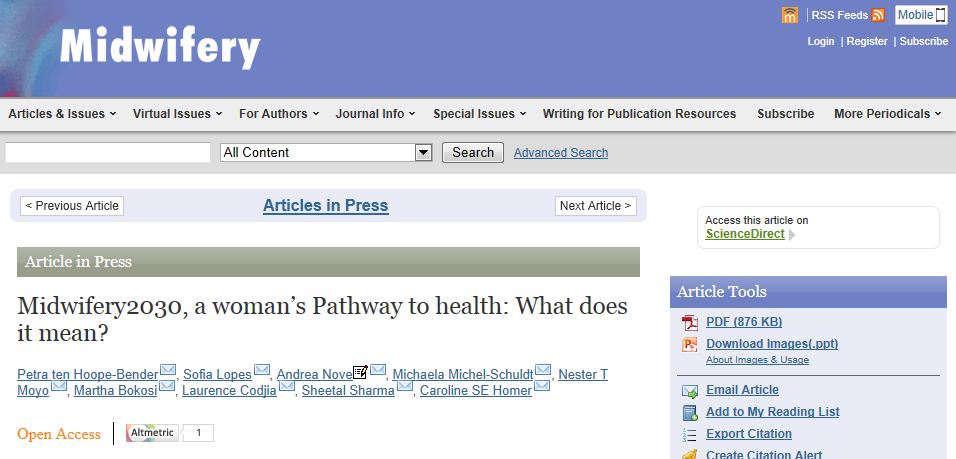
Ms. Sheetal Sharma, PhD student in FHSS, published her latest paper in Midwifery (Elsevier) this week. This latest paper ‘Midwifery2030, a woman’s Pathway to health: What does it mean?’ is co-authored by a number of illustious midwifery researchers. The 2014 State of the World’s Midwifery report included a new framework for the provision of womancentred sexual, reproductive, maternal, newborn and adolescent health care, known as the Midwifery2030 Pathway. The Pathway was designed to apply in all settings (high-, middle- and low income countries, and in any type of health system). This paper describes the process of developing the Midwifery2030 Pathway and explain the meaning of its different components, with a view to assisting countries with its implementation.
Sheetal is currently in her final year of a PhD on the evaluation of the impact of a maternity care intervention in Nepal.
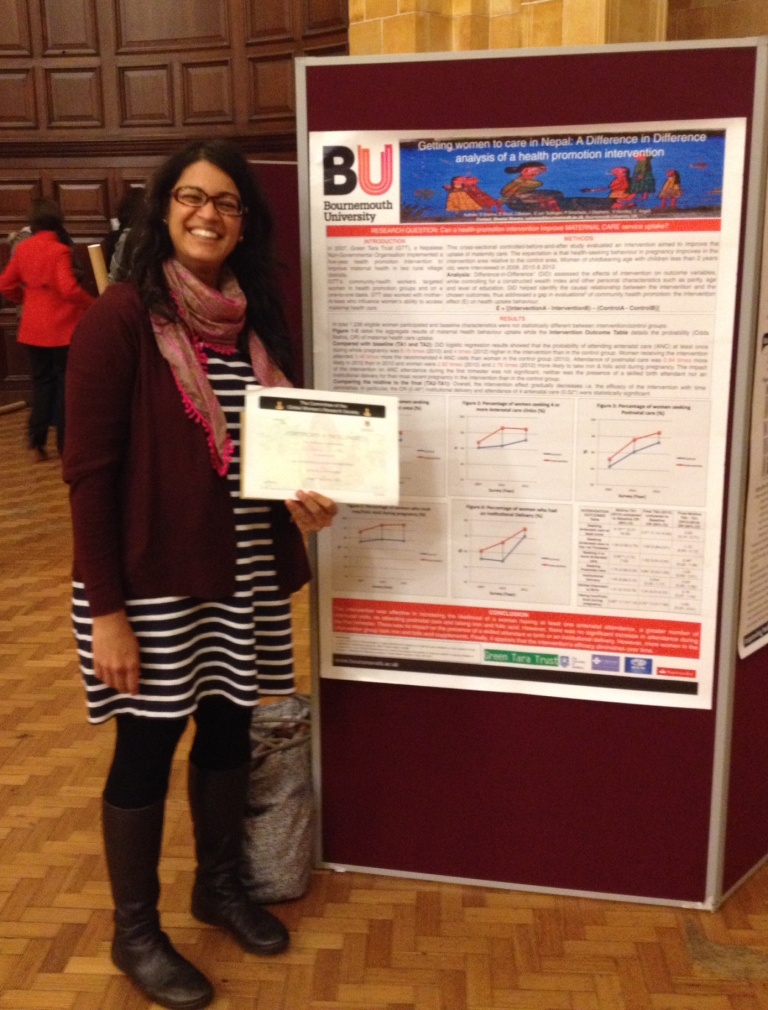
Sheetal Sharma
Congratulations!!
Prof. Edwin van Teijlingen, Dr. Catherine Angell & Prof. Vanora Hundley (all CMMPH)
&
Visiting Faculty Prof. Padam Simkhada (based at Liverpool John Moores University).
Reference:
ten Hoope-Bender, P. Lopes, S., Nove, A., Michel-Schuldt, M., Moyo, NT, Bokosi, M., Codjia, L., Sharma, S., Homer, CSE. (2015) Midwifery2013, a woman’s Pathway to health: What does it mean? Midwifery
 New paper by PhD student Sheetal Sharma
 Congratulations to Sheetal Sharma (HSC)







 International Open Access Week: open access and the REF
 Food Price Research Shortlisted for Civil Service Prize
 3C Event: Research Culture, Community & Connections – Wednesday 11 November 3-4pm
 ECR Opportunities: New Development Programme, Researcher Grants & Upcoming Events
 Horizon Europe Cluster 3 (Civil Security for Society) 2026 Calls Now Open
 MSCA Doctoral Networks 2026 Call Information Webinar
 ESRC Festival of Social Science 2026: Application Deadline Extended to Thursday 25 June 2026
 Reminder: Register for the ESRC Festival of Social Science 2026 Information Session
 ECR Funding Open Call: Research Culture & Community Grant – Apply now
 ERC Advanced Grant 2025 Webinar
 Update on UKRO services
 European research project exploring use of ‘virtual twins’ to better manage metabolic associated fatty liver disease