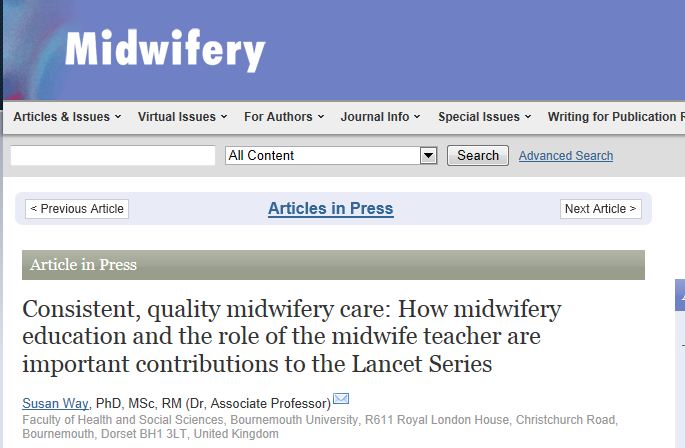
 The forthcoming editorial in Midwifery (Elsevier) by FHSS’s Dr Susan Way highlights the importance of midwifery education and its educators.[1] This editorial makes reference to the recent series on midwifery in The Lancet.[2] Of course, midwifery plays a vital role in improving the quality of care of women and infants globally. Dr. Way reminds us that consistent, high-quality midwifery care has a vital role to play in the reduction of maternal and newborn mortality. Outcomes are enhanced when care is led by midwives who are educated, licensed, regulated, integrated in the health system, and working in interdisciplinary teams, with ready access to specialised care when needed.
Midwifery one of the leading academic journals globally in the field of midwifery and maternity care. Dr.Way is based in the Centre for Midwifery, Maternal & Perinatal Health in FHSS at the Lansdowne Campus.
Congratulations!
Prof. Edwin van Teijlingen
CMMPH
References:
- Way, S. (2015) Consistent, quality midwifery care: How midwifery education and the role of the midwife teacher are important contributions to the Lancet Series, Midwifery (online first) see: http://www.midwiferyjournal.com/article/S0266-6138(16)00021-8/abstract
- Renfrew, M.J., McFadden, A., Bastos, M.H. et al. (2014) Midwifery and quality care: findings from a new evidence-informed framework for maternal and newborn care. the Lancet. 384:1129–1145.
 Midwifery education article by Prof. Hundley
 Midwifery education publication published today







 BU methods paper reached 2,500 reads
 UKCGE Recognised Research Supervision Programme: Applications Close 19 October
 Dr. Orlanda Harvey interviewed as expert
 Dr. Paul Whittington attends Technology and the SEND Reforms Roundtable in the House of Commons
 Dr. Paul Whittington joins Bett 2026 DfE Assistive Technology Roundtable
 BU Prof Jonathan Parker promoting social work in Malaysia
 Horizon Europe Cluster 3 (Civil Security for Society) 2026 Calls Now Open
 MSCA Doctoral Networks 2026 Call Information Webinar
 ESRC Festival of Social Science 2026: Application Deadline Extended to Thursday 25 June 2026
 Reminder: Register for the ESRC Festival of Social Science 2026 Information Session
 ECR Funding Open Call: Research Culture & Community Grant – Apply now
 ERC Advanced Grant 2025 Webinar
 Update on UKRO services
 European research project exploring use of ‘virtual twins’ to better manage metabolic associated fatty liver disease