 Every year the Association of Research Managers and Administrators (ARMA) Conference welcomes research professionals from all over the country to share the latest knowledge, experience and best practice around professional research support. This year the Graduate School attended the ARMA conference hosted in my home city of Birmingham. It was great that our paper entitled ‘A New Model of Training for Doctoral Supervisors at Bournemouth University’ was accepted to be presented at the conference (which attracted over 300 delegates) as it gave us a great opportunity to showcase some of the innovative work being done by the Graduate School. The paper, which highlighted our commitment to the ongoing enhancement of postgraduate supervisory training, was extremely well received and stimulated interesting discussion around the topic. Since the conference, Dr Julia Taylor (Graduate School Academic Manager) has been asked to join the ARMA PGR Special Interest Group as well as provide additional presentations on this topic at future ARMA events. We look forward to our next conference at the UKCGE where we will also be presenting a conference paper.
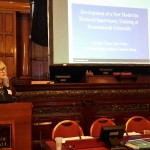 The Graduate School visits Liverpool
 The Graduate School presents … the Researcher Development Programme
BU staff can login below:
Other services







Recent posts
BU research Funding opportunities EU
- Personal Reflection on Sharing Research Through Art: Collaborating to Understand Ageing in a Digital World
 SONAMONI contributions to Safety Conference 2026 in South Africa
- REF adds ‘midwifery’ to Unit of Assessment 3 name
 Three CMWH presentations at Berlin conference
 New interdisciplinary paper on Nepal
- New BU Social Work paper published this week
 Horizon Europe Cluster 3 (Civil Security for Society) 2026 Calls Now Open
 MSCA Doctoral Networks 2026 Call Information Webinar
 ESRC Festival of Social Science 2026: Application Deadline Extended to Thursday 25 June 2026
- Apply now to take part in the 2026 ESRC Festival of Social Science
 Reminder: Register for the ESRC Festival of Social Science 2026 Information Session
 ECR Funding Open Call: Research Culture & Community Grant – Apply now
- MSCA Postdoctoral Fellowships 2025 Call
 ERC Advanced Grant 2025 Webinar
- European Migration Research and Impact – Invitation to a Roundtable Discussion
- MSCA Postdoctoral Fellowships 2025
 Update on UKRO services
 European research project exploring use of ‘virtual twins’ to better manage metabolic associated fatty liver disease
 Research Information Network
- Physical Sciences Case studies: information use and discovery
- Information handling in collaborative research: an exploration of five case studies
- Information literacy monitoring and evaluation
- Data centres: their use, value and impact
- Heading for the open road: costs and benefits of transitions in scholarly communications