In the Independent Review of the Research Excellence Framework, Lord Stern has called for the broadening and deepening of the definition of impact. It is recommended that ‘impacts on public engagement and understanding are emphasised and that impacts on cultural life be specifically included’.
Partnering with librarian Jenny Delasalle, Library Connect has produced a useful and attractive consolidated quick reference guide to some key research impact metrics.
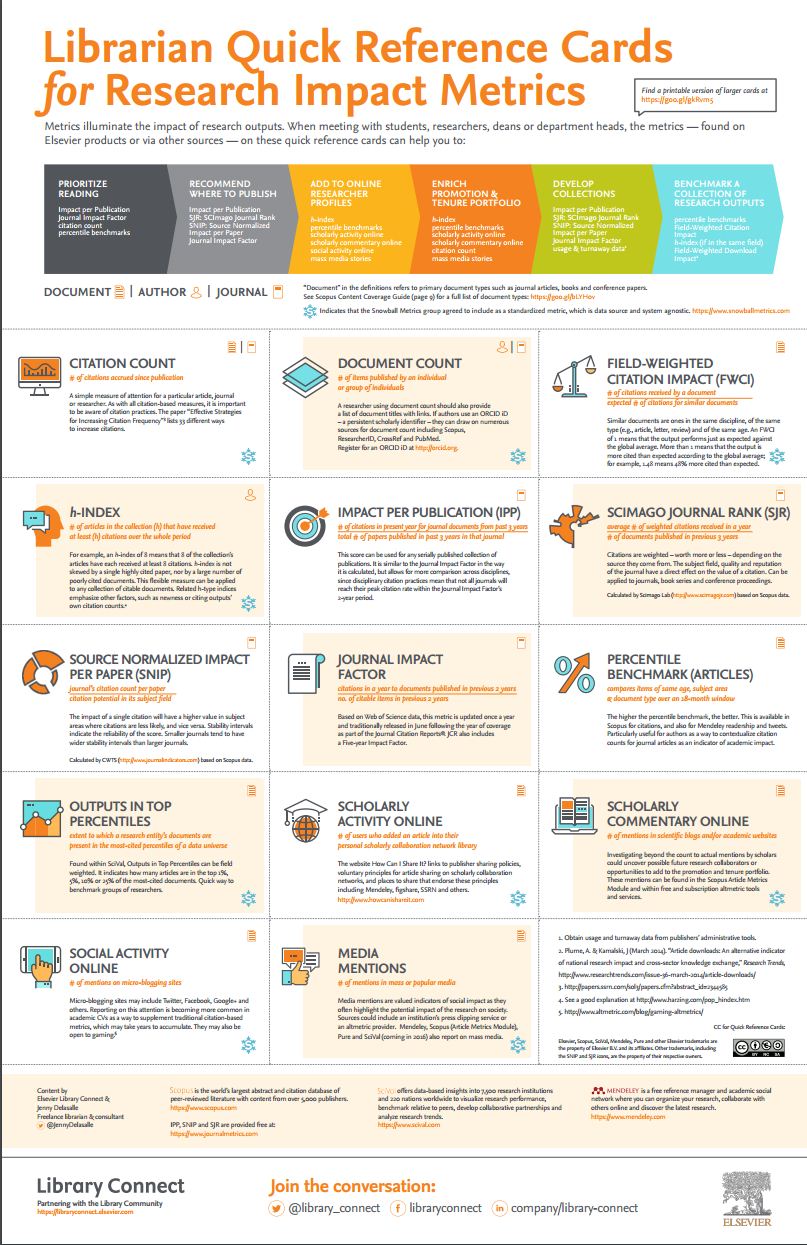
You can download your own copies here –
Download the larger format cards – 4 per 8.5×11″ page
It is important however, that these research metrics are used with these 2 Golden Rules in mind, as recommended by the Library Connect Librarians Feedback Group and Lisa Colledge, Elsevier’s Director of Research Metrics:
Golden Rule 1 – Always use quantitative metric-based input alongside qualitative opinion-based input
Golden Rule 2 – Ensure that the quantitative, metrics part of your input always relies on at least 2 metrics to prevent bias and encouragement of undesirable behaviour.
Original blog post – https://libraryconnect.elsevier.com/metrics
 PlumX Metrics – Webinar
 Monitoring & Evaluating Impact: Free online training session Monday 28 February 2022







 Verbal autopsy paper published two days ago
 ESRC Studentships for 2027 Entry: Opportunity Now Open
 SONAMONI contributions to Safety Conference 2026 in South Africa
 Three CMWH presentations at Berlin conference
 Horizon Europe Cluster 3 (Civil Security for Society) 2026 Calls Now Open
 MSCA Doctoral Networks 2026 Call Information Webinar
 ESRC Festival of Social Science 2026: Application Deadline Extended to Thursday 25 June 2026
 Reminder: Register for the ESRC Festival of Social Science 2026 Information Session
 ECR Funding Open Call: Research Culture & Community Grant – Apply now
 ERC Advanced Grant 2025 Webinar
 Update on UKRO services
 European research project exploring use of ‘virtual twins’ to better manage metabolic associated fatty liver disease