The journal Resuscitation Plus published a systematic review with Debora Almeida in the Department of Midwifery & Health Sciences as lead author. Her latest paper ‘Do automated real-time feedback devices improve CPR quality? A systematic review of literature’ is co-authored with colleagues from Brazil. The review assessed the effectiveness of automated real-time feedback devices for improving CPR (cardiopulmonary resuscitation) performance during training, simulation and real-life resuscitation attempts in the adult and paediatric population. The paper concludes that the use of automated real-time feedback devices enhances skill acquisition and CPR performance during training of healthcare professionals, and secondly, that further research is needed to better understand the role of feedback devices in clinical setting.
Congratulations!
Prof. Edwin van Teijlingen
Centre for Midwifery, Maternal & Perinatal Health (CMMPH)
Reference:
- Gugelmin-Almeida, D., Tobase, L., Polastri, T.F., Peres, H.H.C., Timerman, S. (2021) Do automated real-time feedback devices improve CPR quality? A systematic review of literature, Resuscitation Plus,
6, article: 100108
 Congratulations to Prof. Hundley on her latest systematic review paper
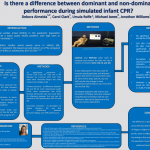 PGR Virtual Poster Exhibition | Debora Almeida







 3C Event: Research Culture, Community & Connections – Wednesday 11 November 3-4pm
 ECR Opportunities: New Development Programme, Researcher Grants & Upcoming Events
 Help us capture BU’s knowledge exchange activity HE-BCI survey 2025–26
 Verbal autopsy paper published two days ago
 ESRC Studentships for 2027 Entry: Opportunity Now Open
 Horizon Europe Cluster 3 (Civil Security for Society) 2026 Calls Now Open
 MSCA Doctoral Networks 2026 Call Information Webinar
 ESRC Festival of Social Science 2026: Application Deadline Extended to Thursday 25 June 2026
 Reminder: Register for the ESRC Festival of Social Science 2026 Information Session
 ECR Funding Open Call: Research Culture & Community Grant – Apply now
 ERC Advanced Grant 2025 Webinar
 Update on UKRO services
 European research project exploring use of ‘virtual twins’ to better manage metabolic associated fatty liver disease