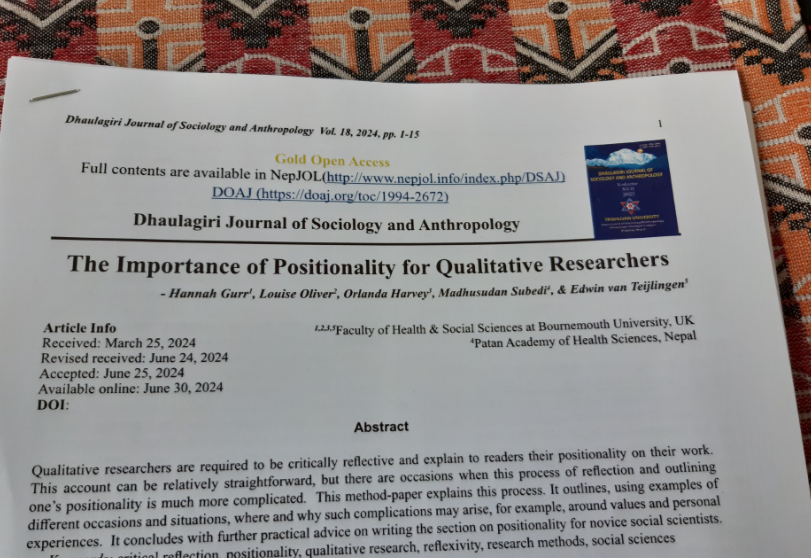
Yesterday ResearchGate alerted us that our paper ‘The importance of positionality for qualitative researchers‘ [1] has been read 500 times.  This methods paper was only written last year by Bournemouth University M.Res. student Hannah Gurr, her M.Res. supervisors Dr. Orlanda Harvey, Dr. Louise Oliver and Prof. Edwin van Teijlingen in collaboration with Prof. Madhusudan Subedi from Patan Academy of Health Sciences in Nepal.
In the paper we remind qualitative researchers about the importance of critical reflection, and why they need to explain their positionality to readers of their work. This account can be relatively straightforward, but there are occasions when this process of reflection and outlining one’s positionality is much more complicated. This method-paper explains this process. It outlines, using examples of different occasions and situations, where and why such complications may arise, for example, around values and personal experiences. It concludes with further practical advice on writing the section on positionality for novice social scientists.
Well done Hannah!
Dr. Lou Oliver, Dr. Orlanda Harvey & Prof. Edwin van Teijlingen
Reference:
- Gurr, H., Oliver, L., Harvey, O., Subedi, M., & van Teijlingen, E. (2024). The Importance of Positionality for Qualitative Researchers. Dhaulagiri Journal of Sociology and Anthropology, 18(1): 48–54. https://doi.org/10.3126/dsaj.v18i01.67553
 Positionality in qualitative research
 BU academics’ paper read 170,000 times!
 Ph.D. paper cited 40 times







 New academic paper on Nepal
 3C Event: Research Culture, Community & Cherry Blossom
 Boost Your Research Profile: Training Sessions with The Conversation
 ESRC Festival of Social Science 2026: An Opportunity to Engage New Audiences
 New HIV paper by BU PhD student
 BU Annual Research Conference: Poster Exhibition Call for Applications
 ECR Funding Open Call: Research Culture & Community Grant – Apply now
 ECR Funding Open Call: Research Culture & Community Grant – Application Deadline Friday 12 December
 MSCA Postdoctoral Fellowships 2025 Call
 ERC Advanced Grant 2025 Webinar
 Update on UKRO services
 European research project exploring use of ‘virtual twins’ to better manage metabolic associated fatty liver disease