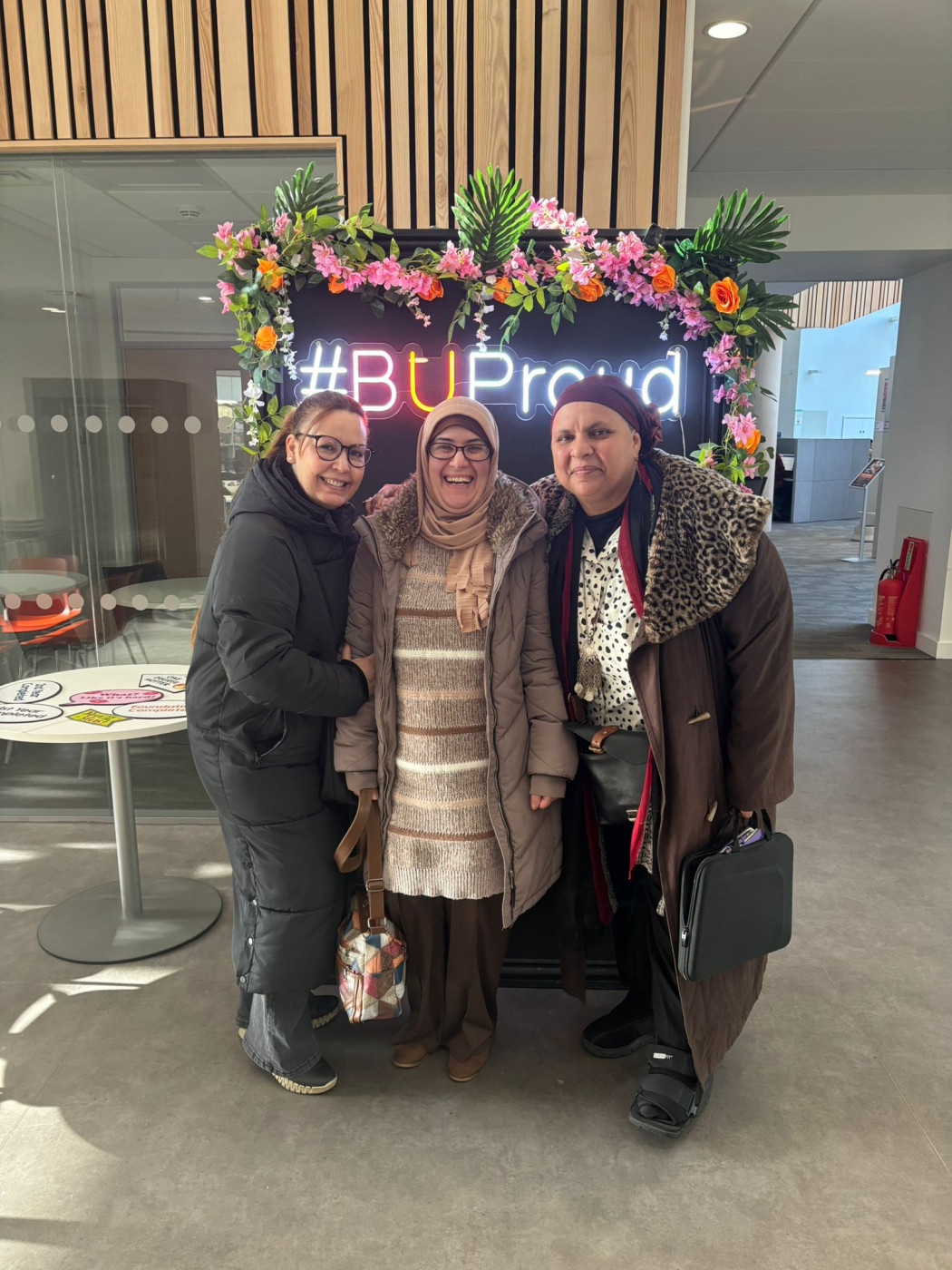
 Postdoctoral Research Fellow Abier Hamidi recently conducted the first of two Patient and Public Involvement workshops with Arabic women. Mentored by Prof. Edwin van Teijlingen and Dr. Pramod Regmi, and funded by FHSS QR Pump Prime, Abier explores Arabic women’s understanding of Violence Against Women and Girls (VAWGs) and their access to health services. During this initial workshop, three Arabic women actively contributed their insights and experiences to refine the questionnaire, design the survey dissemination strategy, and ensured ethical, linguistic, and cultural considerations were met.
The survey is set to launch in May, and with the help of the women, will be distributed nationwide. Once the survey closes, the women will be invited to the second workshop, where they will collaborate with Abier to interpret the results.
Abier Hamidi is a postdoctoral researcher at the Centre for Wellbeing & Long-term Health, working on a Cancer Research UK-funded study under the supervision of Professor Steven Ersser, researching Early Detection of Skin Cancer. Her PhD thesis is titled ‘Understanding the gender and religious context of women and HIV in Libya: A mixed-methods study’. Supervisors: Dr. Pramod Regmi and Prof. Edwin van Teijlingen.
 BU PhD student publishes in The Conversation
 Two scholarships in one month for PhD student







 REF 2029 Sector Survey: Have Your Say
 BU methods paper reached 2,500 reads
 UKCGE Recognised Research Supervision Programme: Applications Close 19 October
 Dr. Orlanda Harvey interviewed as expert
 Dr. Paul Whittington attends Technology and the SEND Reforms Roundtable in the House of Commons
 Dr. Paul Whittington joins Bett 2026 DfE Assistive Technology Roundtable
 Horizon Europe Cluster 3 (Civil Security for Society) 2026 Calls Now Open
 MSCA Doctoral Networks 2026 Call Information Webinar
 ESRC Festival of Social Science 2026: Application Deadline Extended to Thursday 25 June 2026
 Reminder: Register for the ESRC Festival of Social Science 2026 Information Session
 ECR Funding Open Call: Research Culture & Community Grant – Apply now
 ERC Advanced Grant 2025 Webinar
 Update on UKRO services
 European research project exploring use of ‘virtual twins’ to better manage metabolic associated fatty liver disease
Well done Abier, an important topic targeted an underserved group.