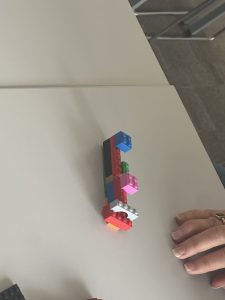
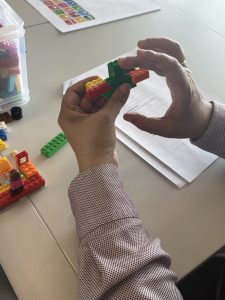
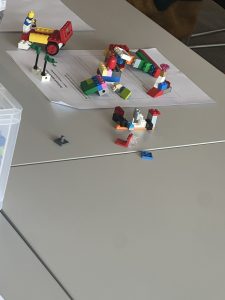
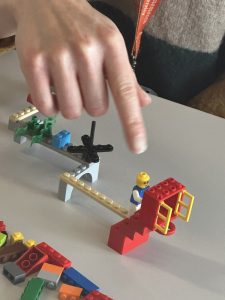
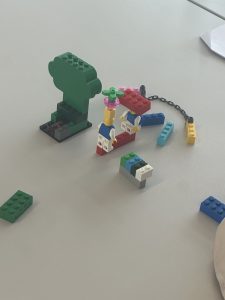
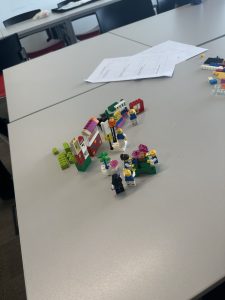
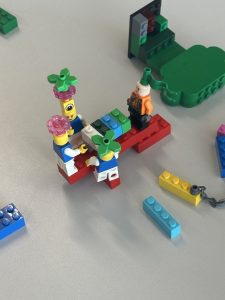
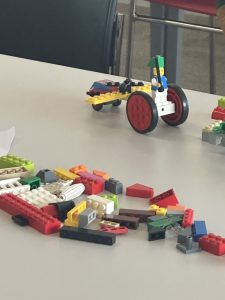
There is a particular silence that falls over a room of academics and practitioners when you put a box of LEGO bricks in front of them and ask them to build what sustainability means in their work. That silence lasts about four seconds. Then someone reaches in.
This afternoon, colleagues from across the University’s Sustainability Academic Network (SAN) sat around a table and did exactly that. The question we had was one that we rarely give ourselves room to think about properly: how do we embed the UN Sustainable Development Goals (UN SDGs) into what and how we teach or work, in a way that means something beyond a line in a validation document or the curriculum? The method was LEGO® Serious Play® (LSP). Facilitated by Stefan Kleipoedzsus and me, it was, by any measure, a generative afternoon.
LSP was developed in the late 1990s by two professors, Johan Roos and Bart Victor, as a way to help senior executives think and talk differently about their organisations (Roos & Victor, 1999; Roos et al., 2004). Its native habitat is adults wrestling with challenging, ambiguous, organisationally-loaded questions, which is a fair description of curriculum design under a sustainability mandate. Released openly in 2010 and now used across start-ups, multinationals and universities alike (Kristiansen & Rasmussen, 2014), the method’s pedigree is corporate strategy, not childhood play with the bricks. Using it with academics is not a gimmick; it returns it to its roots.
But why does it earn its place in staff development?
The cognitive case is well established. Building externalises thinking: when we construct a physical model, we recruit the body’s interaction with the world into our reasoning, surfacing tacit knowledge that talk alone leaves buried (Barsalou, 2008; Wilson, 2002). This is the constructionist premise, that we think most powerfully when we are making something shareable (Papert & Harel, 1991).
But for educators and sustainability practitioners, there is a second, sharper reason. We largely teach as we were taught. If we want colleagues to consider experiential, active pedagogies for their own students, what we can do is have them experience one and then reflect on it. LSP turns staff development into exactly the reflective practice we ask of ourselves as professionals (Schön, 1991); not a lecture about active learning, but the thing itself, felt from the inside. What you do with a method after you have built it with your own hands is a different decision from what you do with one you have only heard described.
Sustainability is a difficult thing to discuss in a room. It is abstract, contested, unevenly understood across disciplines, and easy to deflect with the familiar moves, that’s not relevant to my subject, we already do that, whose definition anyway? A conventional meeting tends to reward whoever is most fluent or most senior.
Building changes the dynamics. When a colleague presents assumptions like height, weight, and form in bricks, it turns into an object on the table, something the group can analyse together rather than a claim to be swiftly rebutted. The convention that a model’s meaning belongs to its creator protects an idea long enough for it to be listened to. Across various faculties and departments with different languages for sustainability, models provided a shared, neutral platform. Statler et al. (2009 and 2011) describe LSP as a way to hold paradox and complexity openly rather than prematurely collapsing them, which is exactly the right approach for the SDGs, where the tensions between goals are not flaws but the core of the work.
But one excellent afternoon is a beginning, not evidence. The trouble with any workshop of this kind is that it generates energy and insight that have evaporated by the following Monday, a memorable session that embeds nothing. It is also true that the people in the room were a self-selecting sustainability network; the method’s more robust test will be the others who are indifferent or unconvinced, and we should not mistake a willing audience for a settled case.
So the test of this work is whether anything in our modules, our assessments and our everyday conversations actually shifts as a result, and whether the alignment with the BU2035 strategy becomes substantive rather than a matter of compliance. What the session did show was where colleagues are, made tacit assumptions visible and shared, and built the cross-faculty relationships that durable curriculum change depends on. We see this as the first move in something larger, and we are already thinking about what a sustained, evidence-based strand of practice looks like beyond a single afternoon. If the method’s history tells us anything, it is that adults do some of their most serious thinking when we let them build.
Barsalou, L. W. (2008). Grounded cognition. Annual Review of Psychology, 59(1), 617–645. https://doi.org/10.1146/annurev.psych.59.103006.093639
Kristiansen, P., & Rasmussen, R. (2014). Building a better business using the LEGO® SERIOUS PLAY® method. Wiley.
Papert, S., & Harel, I. (1991). Constructionism. Norwood, NJ. Ablex Publishing.
Roos, J., & Victor, B. (1999). Towards a new model of strategy-making as serious play. European Management Journal, 17(4), 348–355. https://doi.org/10.1016/S0263-2373(99)00015-8
Roos, J., Victor, B., & Statler, M. (2004). Playing seriously with strategy. Long Range Planning, 37(6), 549–568.https://doi.org/10.1016/j.lrp.2004.09.005
Schön, D. A. (1992). The reflective practitioner: How professionals think in action. Routledge. https://doi.org/10.4324/9781315237473
Statler, M., Heracleous, L., & Jacobs, C. D. (2011). Serious play as a practice of paradox. Journal of Applied Behavioral Science, 47(2), 236–256. DOI:10.1177/0021886311398453
Statler, M., Roos, J., & Victor, B. (2009). Ain’t Misbehavin’: Taking Play Seriously in Organizations. Journal of Change Management, 9, 107 – 87. https://doi.org/10.1080/14697010902727252
Wilson, M. (2002). Six views of embodied cognition. Psychonomic Bulletin & Review, 9(4), 625–636. https://doi.org/10.3758/BF03196322
 Embedding UN SDGs in Teaching Entrepreneurship at BU
 SPROUT: Embedding Sustainability in Doctoral Research Practice







 National Postdoc Appreciation Week 2026: The Changing Landscape of Postdoc Careers
 NIHR Insight South West Central Conference 2026 at Bournemouth University
 BU PhD student presented at World Safety Conference in South Africa
 National Research Supervision Recognition: Apply Now & Join the Supporting Workshop on 16 September
 Horizon Europe Cluster 3 (Civil Security for Society) 2026 Calls Now Open
 MSCA Doctoral Networks 2026 Call Information Webinar
 ESRC Festival of Social Science 2026: Application Deadline Extended to Thursday 25 June 2026
 Reminder: Register for the ESRC Festival of Social Science 2026 Information Session
 ECR Funding Open Call: Research Culture & Community Grant – Apply now
 ERC Advanced Grant 2025 Webinar
 Update on UKRO services
 European research project exploring use of ‘virtual twins’ to better manage metabolic associated fatty liver disease