Back in September 2012, Professor Matthew Bennett, the PVC for Research, Enterprise and Internationalisation announced in a blog post that Bournemouth University was in the process of applying for membership of the Athena SWAN Charter, which was a positive and significant development for the University.
The Athena Swan charter recognises commitment to advancing women’s careers in science, technology, engineering, maths and medicine (STEMM) employment in higher education and is underpinned by three beliefs:
- The advancement of science, technology, engineering, maths and medicine is fundamental to quality of life across the globe
- It is vitally important that women are adequately represented in what has traditionally been, and is still, a male-dominated area
- Science cannot reach its full potential unless it can benefit from the talents of the whole population, and until women and men can benefit equally from the opportunities it affords
(information taken from http://www.athenaswan.org.uk/content/charter)
The University of Southampton, supported by EPSRC is hosting a Gender Equality Conference “Athena SWAN and Beyond” on the 20 March 2013. This is a FREE event and is a fantastic opportunity for those who are keen to get involved with Athena SWAN.
Event details are as below
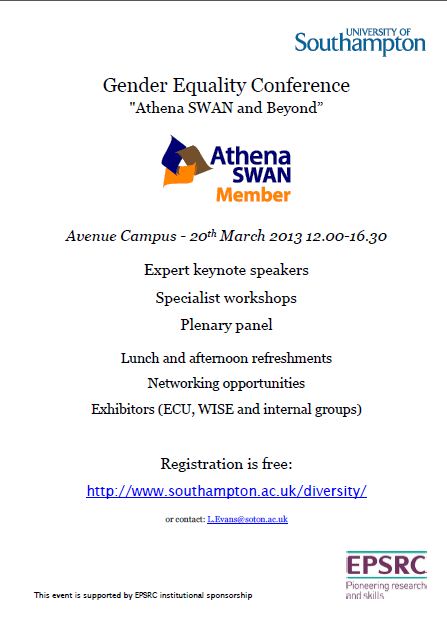
To register for the event, please visit this webpage http://www.southampton.ac.uk/diversity/
You can also find out more about the event from here.
 Athena SWAN – latest news and information
 Athena SWAN – February Newsletter







 3C Event: Research Culture, Community & Connections – Wednesday 11 November 3-4pm
 ECR Opportunities: New Development Programme, Researcher Grants & Upcoming Events
 Help us capture BU’s knowledge exchange activity HE-BCI survey 2025–26
 Verbal autopsy paper published two days ago
 ESRC Studentships for 2027 Entry: Opportunity Now Open
 Horizon Europe Cluster 3 (Civil Security for Society) 2026 Calls Now Open
 MSCA Doctoral Networks 2026 Call Information Webinar
 ESRC Festival of Social Science 2026: Application Deadline Extended to Thursday 25 June 2026
 Reminder: Register for the ESRC Festival of Social Science 2026 Information Session
 ECR Funding Open Call: Research Culture & Community Grant – Apply now
 ERC Advanced Grant 2025 Webinar
 Update on UKRO services
 European research project exploring use of ‘virtual twins’ to better manage metabolic associated fatty liver disease