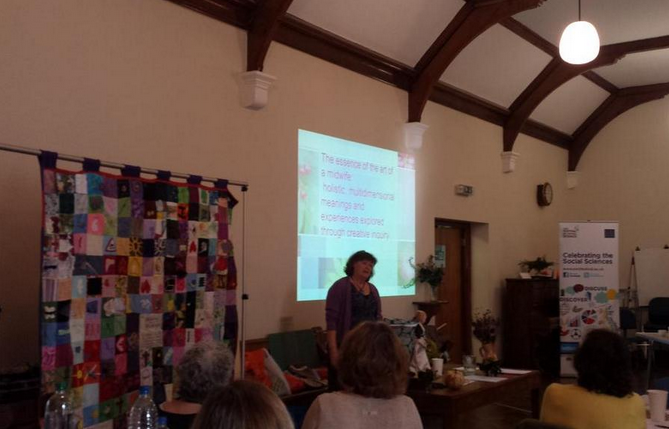
 On 5th November Jenny Hall, Senior Midwifery Lecturer, presented at an event organised for the ‘Thinking Futures’ festival for the University of Bristol. http://www.bristol.ac.uk/fssl/festival/
The festival was an eleven day series of lectures to share and celebrate research from the Faculty of Social science and Law and had sponsorship from the ESRC Festival of social science. The sponsorship meant that it was open to the public and therefore anyone could turn up.
The day was called ‘Patchwork, quilting and keeping it all going’ and arranged by inspirational Management academic and quilt researcher Ann Rippin http://annjrippin.wordpress.com/ Ann placed in social and historical context the study of quilting and the history of quilters, identifying the lack of research around this significant social activity. Harriett Shortt from the business school at UWE Bristol shared how she had developed a quilt as a response to her PhD studies.
http://harrietshortt.wordpress.com/ Jenny also talked about the process of reflexivity in her EdD study around developing her quilt as well as the creation of ‘text quilts’. The audience included researchers as well as members of the public active in stitching. Overall it was a day that stimulated a lot of discussion around the use of creative craft in life as well as research and highlighted the need for more work around quilters to be carried out.
BU staff can login below:
Other services







Recent posts
BU research Funding opportunities EU
 3C Event: Research Culture, Community & Connections – Wednesday 11 November 3-4pm
 ECR Opportunities: New Development Programme, Researcher Grants & Upcoming Events
 Help us capture BU’s knowledge exchange activity HE-BCI survey 2025–26
 Verbal autopsy paper published two days ago
 ESRC Studentships for 2027 Entry: Opportunity Now Open
- Personal Reflection on Sharing Research Through Art: Collaborating to Understand Ageing in a Digital World
 Horizon Europe Cluster 3 (Civil Security for Society) 2026 Calls Now Open
 MSCA Doctoral Networks 2026 Call Information Webinar
 ESRC Festival of Social Science 2026: Application Deadline Extended to Thursday 25 June 2026
- Apply now to take part in the 2026 ESRC Festival of Social Science
 Reminder: Register for the ESRC Festival of Social Science 2026 Information Session
 ECR Funding Open Call: Research Culture & Community Grant – Apply now
- MSCA Postdoctoral Fellowships 2025 Call
 ERC Advanced Grant 2025 Webinar
- European Migration Research and Impact – Invitation to a Roundtable Discussion
- MSCA Postdoctoral Fellowships 2025
 Update on UKRO services
 European research project exploring use of ‘virtual twins’ to better manage metabolic associated fatty liver disease
 Research Information Network
- Physical Sciences Case studies: information use and discovery
- Information handling in collaborative research: an exploration of five case studies
- Information literacy monitoring and evaluation
- Data centres: their use, value and impact
- Heading for the open road: costs and benefits of transitions in scholarly communications