 Annals of Tourism Research, Vol.80, https://doi.org/10.1016/j.annals.2019.02.012
Download FREE Now https://authors.elsevier.com/c/1aSE6aZ3ER7Ql
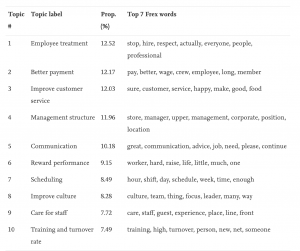
The informational value of online employee reviews in tourism and hospitality research and practice. Online reviews can complement existing approaches offering access in a pool of opinion highly representative of the industry. The results of our analysis reveal that the unstructured form of reviews through topic analysis can efficiently capture important topics for employees and is in agreement with previous literature. As such it opens new avenues for researchers and practitioners since the intangible and heterogeneous nature of tourism and hospitality services can be measured with more direct data sources available to the decision makers, than cross-sectional questionnaires.
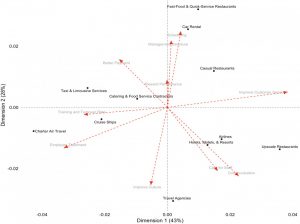
An interesting insight for managers in these industries is that the adaptation of management practices and improvement initiatives needs to be adjusted vertically (across business units) rather than horizontally (across the organization). The results of the analysis also provide an argument against the “one size fits all” approach (Hom, Lee, Shaw, & Hausknecht, 2017) in the management of service employees across tourism and hospitality industries and as such the incorporation of insights from satisfaction surveys in managerial practices need to be adjusted accordingly.
 Conversation article: Online reviews are broken – here’s how to fix them







 3C Event: Research Culture, Community & Connections – Wednesday 11 November 3-4pm
 ECR Opportunities: New Development Programme, Researcher Grants & Upcoming Events
 Help us capture BU’s knowledge exchange activity HE-BCI survey 2025–26
 Verbal autopsy paper published two days ago
 ESRC Studentships for 2027 Entry: Opportunity Now Open
 Horizon Europe Cluster 3 (Civil Security for Society) 2026 Calls Now Open
 MSCA Doctoral Networks 2026 Call Information Webinar
 ESRC Festival of Social Science 2026: Application Deadline Extended to Thursday 25 June 2026
 Reminder: Register for the ESRC Festival of Social Science 2026 Information Session
 ECR Funding Open Call: Research Culture & Community Grant – Apply now
 ERC Advanced Grant 2025 Webinar
 Update on UKRO services
 European research project exploring use of ‘virtual twins’ to better manage metabolic associated fatty liver disease