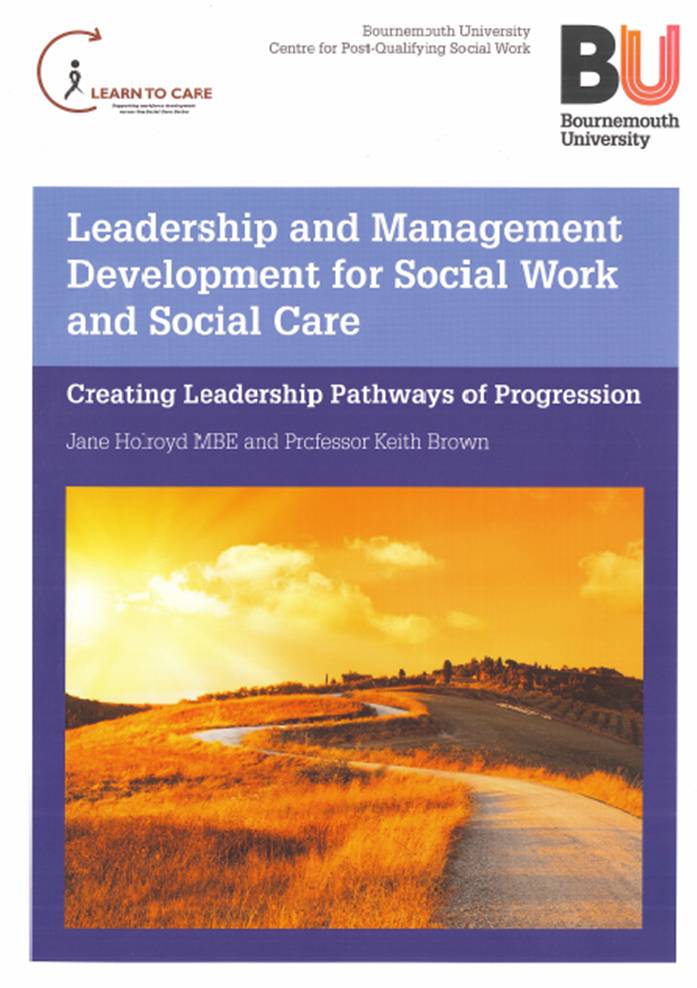
A new report that will serve as a blueprint for effective leadership in social work and social care has just been published by the Centre for Post-Qualifying Social Work at BournemouthUniversity.
Entitled ‘Leadership and Management Development for Social Work and Social Care: Creating Leadership Pathways of Progression’, the ground-breaking report is co-authored by Professor Keith Brown, Director of the Centre, and Jane Holroyd MBE on behalf of Learn to Care, the body which represents workforce development managers from all local authorities in England.
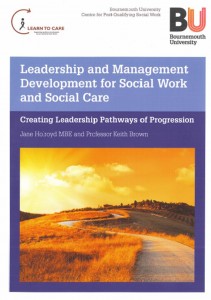 The report provides the UK’s first framework for establishing an effective Leadership and Management pathway in social work and social care. It addresses the major concerns and recommendations identified following the Peter Connelly case by the Social Work Reform Board (2009) and the Munro Review of Child Protection Services (2011) in terms of the call for a clear leadership and management strategy for front line social work managers.
This new framework has been developed over the past 18 months and has involved rigorous testing and piloting. A new underpinning theory and approach, Self-Leadership, which critically emphasises the quality of thinking and developing the abilities to manage self as part of improving personal and organisational performance, has been developed by Professor Brown and Jane Holroyd. Holroyd suggests this model is applicable to all professions, whatever their managerial position, as all professionals will be leaders within their own sphere of influence.
The report also highlights the critical role of assessment and evaluation to demonstrate that individuals have reached the required levels of competence and that a return on the investment is evidenced.
Conor Burns, MP for Bournemouth West, has hailed the framework as enormously important for the future of long term care in the UK.
“Reputationally for Bournemouth University, this is an incredibly important breakthrough. What we are currently doing with social work and social care training is teaching without testing and training without measuring the impact,” he said.
“As a state, we are spending millions and millions and not questioning the effectiveness of that spend”.
The Centre for Post Qualifying Social Work at Bournemouth University is at the leading edge of post qualifying social work education in the UK. It works with over one third of all local authorities in England and over 70 major employers, including training social workers within the armed forces.
The Centre’s portfolio of courses are designed to raise standards in social work practice and help those in social work and social care demonstrate their competence to work within complex situations with the most vulnerable in our society.
Of particular note, this leadership framework has been developed to meet the requirements of the NHS Leadership Qualities Framework and it is anticipated that this will be of real value, especially as we see increasing integration between the NHS and Local Authority community services in the coming months.
You can order a copy of the publication by emailing kbrown@bournemouth.ac.uk
 National Competence Framework for Safeguarding Adults



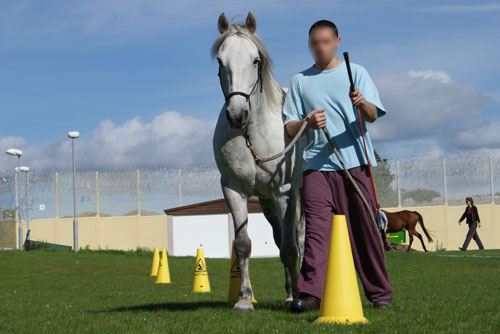
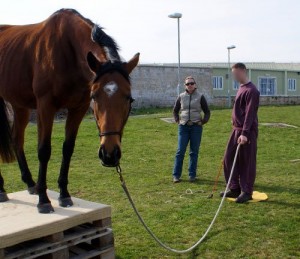 One of the participants has commented: “”I’ve been on anger management courses, alcohol courses, things like that – this is much different, you’re learning it physical, not mental if you know what I mean. It’s helped me more, without a doubt. I don’t like talking. …Normally, with other courses you’re in a group of people… you have to talk about your issues and things like that, but here you get it out in a different way, you’re doing physical things not just talking. I’ve been doing that since I was 6 years of age and it’s never worked. I learnt a lot about myself. I can actually do things. I always say I can’t but I can.”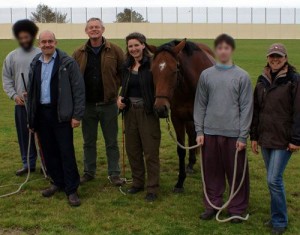







 ESRC Festival of Social Science 2026: An Opportunity to Engage New Audiences
 New HIV paper by BU PhD student
 BU Annual Research Conference: Poster Exhibition Call for Applications
 Vitae Three Minute Thesis (3MT®) Competition: Applications Now Open
 3C Online Social: Thursday 26 March 1–2pm – Research Culture, Community & Can you Guess Who?
 ECR Funding Open Call: Research Culture & Community Grant – Apply now
 ECR Funding Open Call: Research Culture & Community Grant – Application Deadline Friday 12 December
 MSCA Postdoctoral Fellowships 2025 Call
 ERC Advanced Grant 2025 Webinar
 Update on UKRO services
 European research project exploring use of ‘virtual twins’ to better manage metabolic associated fatty liver disease