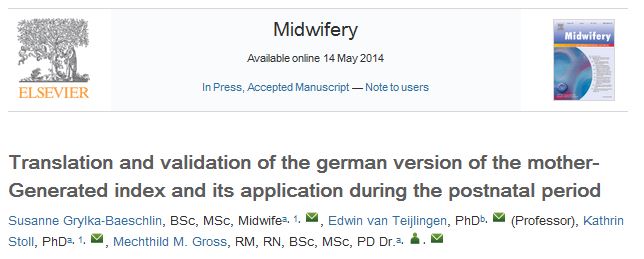
The Mother-Generated Index (MGI) is a validated tool to assess postnatal quality of life. It was originally designed and tested by Dr. Andrew Symon (http://nursingmidwifery.dundee.ac.uk/staff-member/dr-andrew-symon) at the University of Dundee. This instrument is usually administered several weeks or months after birth and correlates with indices of postpartum mood states and physical complaints. The instrument had not been translated into German before or validated for use among German-speaking women, nor have the results of the tool been assessed specifically for the administration directly after birth. Our recent paper (Susanne Grylka-Baeschlin, Edwin van Teijlingen, Kathrin Stoll and Mechthild Gross) in Midwifery describes the systematic translation process of the MGI into German and to assess the convergent validity of the German version of the instrument directly after birth and seven weeks postpartum
Susanne Grylka-Baeschlin, as part of a European COST Action, has spent time at Bournemouth University’s Centre for Midwifery, Maternal and Perinatal Health. Susanne Grylka-Bäschlin is a Swiss midwife based at the Hannover Medical School, Germany, who studies cultural differences in postnatal quality of life among German-speaking women in Switzerland and Germany.
Prof. Edwin van Teijlingen
CMMPH
 Latest HSC Midwifery paper in Open Access
 September: A good month for CMMPH publications







 International Open Access Week: BU support for open access
 Food Price Research Shortlisted for Civil Service Prize
 3C Event: Research Culture, Community & Connections – Wednesday 11 November 3-4pm
 ECR Opportunities: New Development Programme, Researcher Grants & Upcoming Events
 Help us capture BU’s knowledge exchange activity HE-BCI survey 2025–26
 Horizon Europe Cluster 3 (Civil Security for Society) 2026 Calls Now Open
 MSCA Doctoral Networks 2026 Call Information Webinar
 ESRC Festival of Social Science 2026: Application Deadline Extended to Thursday 25 June 2026
 Reminder: Register for the ESRC Festival of Social Science 2026 Information Session
 ECR Funding Open Call: Research Culture & Community Grant – Apply now
 ERC Advanced Grant 2025 Webinar
 Update on UKRO services
 European research project exploring use of ‘virtual twins’ to better manage metabolic associated fatty liver disease