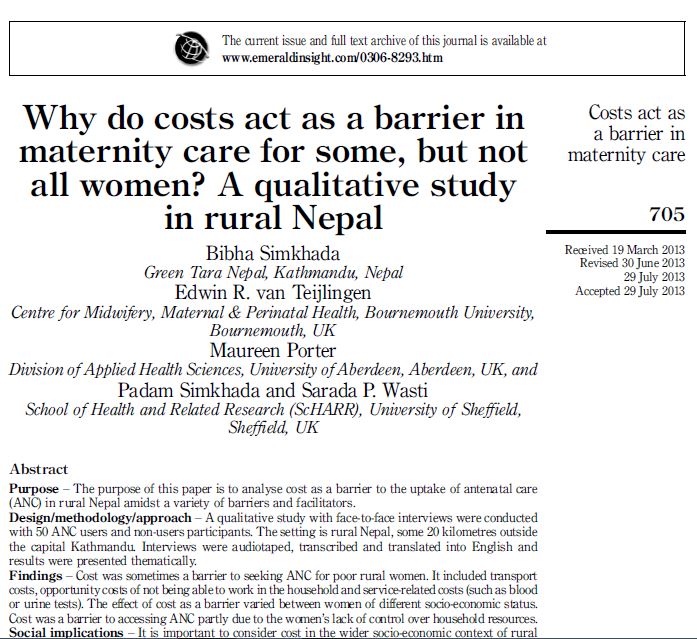
Congratulations to Bournemouth University’s Visiting Faculty Dr. Bibha Simkhada and Prof. Padam Simkhada for the paper on financial barriers to the uptake of antenatal care in a rural community in Nepal.1 The first author (a native Nepali-speaker) conducted 50 face-to-face interviews with women and their families in rural Nepal. These interviews were thematically analysed after transcription.
This latest paper adds to our knowledge into user costs related to maternity services in Nepal as we had already published our findings on users costs in the largest obstetric hospital in the capital. 2
Professor Edwin van Teijlingen
CMMPH
References:
- Simkhada, B., van Teijlingen, E.R., Porter, M., Simkhada, P. & Wasti, S.P. (2014) Why do costs act as a barrier in maternity care for some, but not all women? A qualitative study in rural Nepal International Journal of Social Economics 41 (8), 705-713
- Simkhada, P.P., van Teijlingen, E., Sharma, G., Simkhada, B., Townend, J. (2012) User costs and informal payments for care in the largest maternity hospital in Kathmandu, Nepal, Health Science Journal 6(2): 317-334. www.hsj.gr/volume6/issue2/6212.pdf
 Latest HSC paper in Birth







 3C Event: Research Culture, Community & Connections – Wednesday 11 November 3-4pm
 ECR Opportunities: New Development Programme, Researcher Grants & Upcoming Events
 Help us capture BU’s knowledge exchange activity HE-BCI survey 2025–26
 Verbal autopsy paper published two days ago
 ESRC Studentships for 2027 Entry: Opportunity Now Open
 Horizon Europe Cluster 3 (Civil Security for Society) 2026 Calls Now Open
 MSCA Doctoral Networks 2026 Call Information Webinar
 ESRC Festival of Social Science 2026: Application Deadline Extended to Thursday 25 June 2026
 Reminder: Register for the ESRC Festival of Social Science 2026 Information Session
 ECR Funding Open Call: Research Culture & Community Grant – Apply now
 ERC Advanced Grant 2025 Webinar
 Update on UKRO services
 European research project exploring use of ‘virtual twins’ to better manage metabolic associated fatty liver disease