 Sometimes my co-authors and I wonder why a particular paper get more cited after a few years of publication. Is is because the paper and the research were are ahead of their time? Or is there simply a lag time between publication and other researchers publishing in the field finding your paper (or stumbling upon it perhaps)?
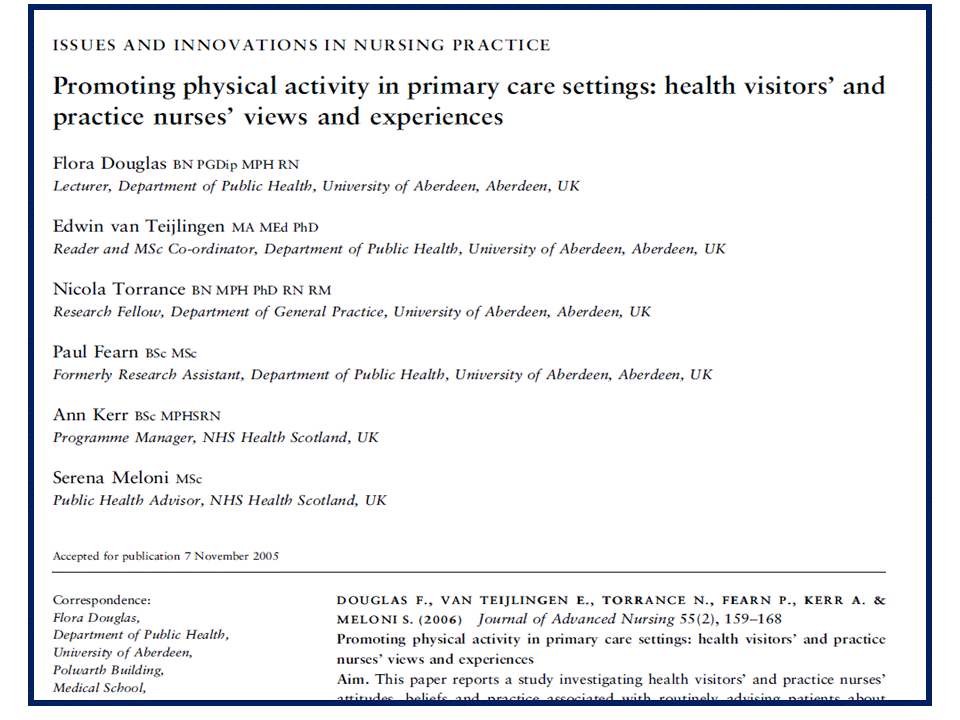
Take for example the following paper published in 2006 when I was still based in the Department of Public Health at the University of Aberdeen: Promoting physical activity in primary care settings: Health visitors’ and practice nurses’ views and experiences in the Journal of Advanced Nursing.[1]
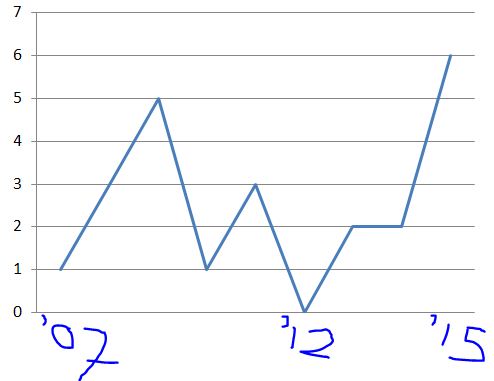
Published in 2006 our paper was first cited in Scopus in 2007 (just once),three time in the following year (2008), five times in 2009 and then just a few times per year until this year. In 2015 we have six citations already and the year is not even finished.
We really wonder what lies behind that increased popularity of this 2006 paper.
Prof. Edwin van Teijlingen
CMMPH
Reference:
- Douglas, F., van Teijlingen E.R., Torrance, N., Fearn, P., Kerr, A., Meloni, S. (2006) Promoting physical activity in primary care settings: Health visitors’ and practice nurses’ views and experiences Journal of Advanced Nursing, 55(2): 159-168.
 Paper by BU academics used as example in Dutch university newsletter







 BU methods paper reached 2,500 reads
 UKCGE Recognised Research Supervision Programme: Applications Close 19 October
 Dr. Orlanda Harvey interviewed as expert
 Dr. Paul Whittington attends Technology and the SEND Reforms Roundtable in the House of Commons
 Dr. Paul Whittington joins Bett 2026 DfE Assistive Technology Roundtable
 BU Prof Jonathan Parker promoting social work in Malaysia
 Horizon Europe Cluster 3 (Civil Security for Society) 2026 Calls Now Open
 MSCA Doctoral Networks 2026 Call Information Webinar
 ESRC Festival of Social Science 2026: Application Deadline Extended to Thursday 25 June 2026
 Reminder: Register for the ESRC Festival of Social Science 2026 Information Session
 ECR Funding Open Call: Research Culture & Community Grant – Apply now
 ERC Advanced Grant 2025 Webinar
 Update on UKRO services
 European research project exploring use of ‘virtual twins’ to better manage metabolic associated fatty liver disease