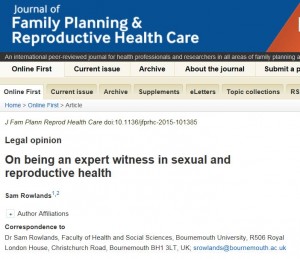
 Dr. Sam Rowlands, FHSS Visiting Faculty, has just published an interesting article on ‘On being an expert witness in sexual and reproductive health’. The paper will appear in the Journal of Family Planning & Reproductive Health Care [1]. In this article Sam highlights that expert witnesses need to be able to apply appropriate legal tests to the evidence, to deal with the range of expert opinion on a matter, and explain clearly what constitutes an appropriate standard of care for a clinician in their discipline and specialty. They must be aware of pitfalls such as being sued for substandard work and being reported to their professional regulator for straying outside their area of expertise. Expert witnesses must be truly independent and ideally their reports should be the same whoever they receive their instructions from.
Congratulations!
Prof. Edwin van Teijlingen
CMMPH
Reference:
Rowlands, S. ‘On being an expert witness in sexual and reproductive health’. J Fam Plann Reprod Health Care doi:10.1136/jfprhc-2015-101385 (forthcoming/online first)
 New collaborative publication FHSS PhD students, staff & Visiting Faculty
 Congratulations to Dr. Pramod Regmi now Visiting Faculty at Datta Meghe Inst. Med. Sci. [India]







 ESRC Studentships for 2027 Entry: Opportunity Now Open
 SONAMONI contributions to Safety Conference 2026 in South Africa
 Three CMWH presentations at Berlin conference
 New interdisciplinary paper on Nepal
 Horizon Europe Cluster 3 (Civil Security for Society) 2026 Calls Now Open
 MSCA Doctoral Networks 2026 Call Information Webinar
 ESRC Festival of Social Science 2026: Application Deadline Extended to Thursday 25 June 2026
 Reminder: Register for the ESRC Festival of Social Science 2026 Information Session
 ECR Funding Open Call: Research Culture & Community Grant – Apply now
 ERC Advanced Grant 2025 Webinar
 Update on UKRO services
 European research project exploring use of ‘virtual twins’ to better manage metabolic associated fatty liver disease