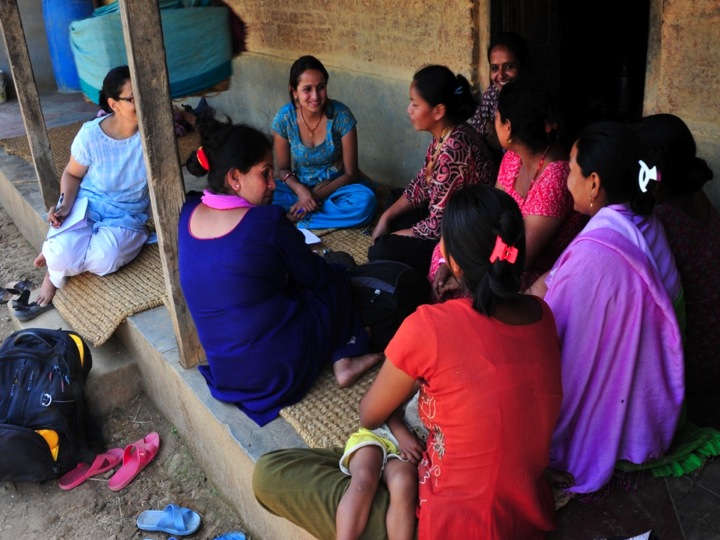
Focus groups in open air in rural Nepal, (c) Sheetal Sharma
Congratulations to Sheetal Sharma, postgraduate student in the Centre for Midwifery, Maternal & Perinatal Health (CMMPH) whose latest paper on the process of the research in her PhD fieldwork was accepted today by the Journal of Asian Midwives [1]. Sheetal used an innovative mixed-methods evaluation which was applied to a long-running maternity intervention in rural Nepal. The intervention has been supported for nearly seven years by Green Tara Trust, a Buddhist charity based in London. Sheetal’s supervisors are supervisors are Prof. Vanora Hundley, Prof. Edwin van Teijlingen, Dr. Catherine Angell (all in CMMPH) and Prof. Padam Simkhada, who is Visiting Faculty in the Faculty of Health & Social Sciences and based at Liverpool John Moores University.
This paper is part of a larger body of health research work conducted by CMMPH in Nepal.
Reference:
Sharma, S., Simkhada, P., van Teijlingen, E., Stephens J, Hundley, V., Angell, C. (2017) Evaluation of Maternity Care Intervention in Rural Nepal: Lessons learnt, Journal of Asian Midwives (accepted Jan. 2017).
 New CMMPH paper by PhD student Sheetal Sharma
 New publication Sheetal Sharma (PhD graduate 2017)
 New paper BU PhD student Sheetal Sharma







 Food Price Research Shortlisted for Civil Service Prize
 It’s International Open Access week
 3C Event: Research Culture, Community & Connections – Wednesday 11 November 3-4pm
 ECR Opportunities: New Development Programme, Researcher Grants & Upcoming Events
 Help us capture BU’s knowledge exchange activity HE-BCI survey 2025–26
 Verbal autopsy paper published two days ago
 Horizon Europe Cluster 3 (Civil Security for Society) 2026 Calls Now Open
 MSCA Doctoral Networks 2026 Call Information Webinar
 ESRC Festival of Social Science 2026: Application Deadline Extended to Thursday 25 June 2026
 Reminder: Register for the ESRC Festival of Social Science 2026 Information Session
 ECR Funding Open Call: Research Culture & Community Grant – Apply now
 ERC Advanced Grant 2025 Webinar
 Update on UKRO services
 European research project exploring use of ‘virtual twins’ to better manage metabolic associated fatty liver disease
