
Diabetes is the leading cause of kidney failure in the UK. In collaboration with the University of Bristol, BU is in receipt of (another) three year grant that ultimately, we hope, will lead to the discovery of new treatments to prevent kidney failure developing in patients with diabetes.
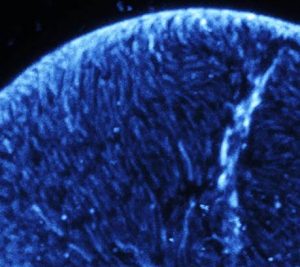
The work, using patient data and BU’s Drosophila (fruit fly) kidney model, will look at how preventing the disruption of energy within kidney filtration cells called podocytes might slow or prevent kidney failure. The image shows the surface of a podocyte-like cell within a fruit fly, with linear arrays of filtration slits covering its surface. These minute structures are common to both human and fly cells and become damaged when energy is depleted in the cells – leading to loss of cell function. Flies allows us to understand the molecular basis of how this leads to kidney failure in humans – and guides us as to which molecules to target in the patients.
Dr. Paul S. Hartley.
 Strong Presence of BU at UK Kidney Week







 3C Event: Research Culture, Community & Connections – Wednesday 11 November 3-4pm
 ECR Opportunities: New Development Programme, Researcher Grants & Upcoming Events
 Help us capture BU’s knowledge exchange activity HE-BCI survey 2025–26
 Verbal autopsy paper published two days ago
 ESRC Studentships for 2027 Entry: Opportunity Now Open
 Horizon Europe Cluster 3 (Civil Security for Society) 2026 Calls Now Open
 MSCA Doctoral Networks 2026 Call Information Webinar
 ESRC Festival of Social Science 2026: Application Deadline Extended to Thursday 25 June 2026
 Reminder: Register for the ESRC Festival of Social Science 2026 Information Session
 ECR Funding Open Call: Research Culture & Community Grant – Apply now
 ERC Advanced Grant 2025 Webinar
 Update on UKRO services
 European research project exploring use of ‘virtual twins’ to better manage metabolic associated fatty liver disease