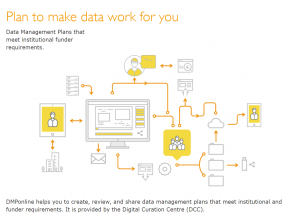
Image captured from the official website of DMP Online (Accessed 27 November 2020).
What is a Data Management Plan?
Data Management Plans (DMPs) document how data generated during a research project will be managed and preserved for reuse. Funders are taking this increasingly seriously and are evaluating the strength of DMPs when assessing bids for research funding.
Who does it apply to?
Staff undertaking research and PGRs.
What is DMP Online?
DMP Online is a data management planning tool. Created by the Digital Curation Centre (DCC), it enables researchers to write DMPs using funder templates. It also benefits from:
- Integrated guidance
- Tools to enable collaboration with colleagues/supervisors/library support
DMP Online is highly recommended, helping researchers to meet funder expectations. There is also a BU template for all other projects.
Where to go for more information and support
The Library has developed an extensive Research Data Management (RDM) guide, which includes guidance for DMPs.
Email bordar@bournemouth.ac.uk for additional support.
Image credit:
Digital Curation Centre, 2020. DMPonline [online]. Available at: https://dmponline.dcc.ac.uk/ [Accessed 27 November 2020].
 Research Data Management and Sharing – MOOC







 Verbal autopsy paper published two days ago
 ESRC Studentships for 2027 Entry: Opportunity Now Open
 SONAMONI contributions to Safety Conference 2026 in South Africa
 Three CMWH presentations at Berlin conference
 Horizon Europe Cluster 3 (Civil Security for Society) 2026 Calls Now Open
 MSCA Doctoral Networks 2026 Call Information Webinar
 ESRC Festival of Social Science 2026: Application Deadline Extended to Thursday 25 June 2026
 Reminder: Register for the ESRC Festival of Social Science 2026 Information Session
 ECR Funding Open Call: Research Culture & Community Grant – Apply now
 ERC Advanced Grant 2025 Webinar
 Update on UKRO services
 European research project exploring use of ‘virtual twins’ to better manage metabolic associated fatty liver disease