Professor Tim Darvill, Kerry Barrass, Yvette Staelens from the Department of Archaeology and Anthropology (BU) together with Dr Vanessa Heaslip from the Department of Nursing Science (BU) worked with Laura Drysdale of the Restoration Trust to edit a book exploring how historic landscapes could support mental health well-being.
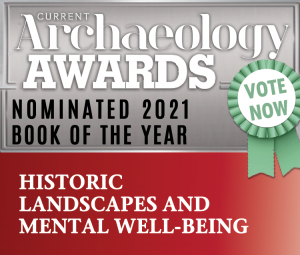
Our book titled ‘Historic Landscapes and Mental Health Well-being’ has been nominated as a contender in the 2021 Current Archaeology Book of the Year competition. This is fantastic news and really shows the benefits of cross disciplinary research and working.
Voting is open now at www.archaeology.co.uk/vote so do please cast your votes for the book, and encourage anyone else you can think of to do the same. Please also feel free to share this excellent news in your social media sites as it would be really excellent to win this award. The results will be announced at the Archaeology in Britain conference in February.
Please keep your fingers crossed for us and thank you for your votes
 Professor Julie Turner-Cobb wins the British Psychological Society Book Award!
 Congratulations to Professor Julian McDougall whose book has been shortlisted for the UKLA Academic Book Award 2018.
 HISTORIC LANDSCAPES AND MENTAL WELL-BEING







 REF 2029 Sector Survey: Have Your Say
 BU methods paper reached 2,500 reads
 UKCGE Recognised Research Supervision Programme: Applications Close 19 October
 Dr. Orlanda Harvey interviewed as expert
 Dr. Paul Whittington attends Technology and the SEND Reforms Roundtable in the House of Commons
 Dr. Paul Whittington joins Bett 2026 DfE Assistive Technology Roundtable
 Horizon Europe Cluster 3 (Civil Security for Society) 2026 Calls Now Open
 MSCA Doctoral Networks 2026 Call Information Webinar
 ESRC Festival of Social Science 2026: Application Deadline Extended to Thursday 25 June 2026
 Reminder: Register for the ESRC Festival of Social Science 2026 Information Session
 ECR Funding Open Call: Research Culture & Community Grant – Apply now
 ERC Advanced Grant 2025 Webinar
 Update on UKRO services
 European research project exploring use of ‘virtual twins’ to better manage metabolic associated fatty liver disease