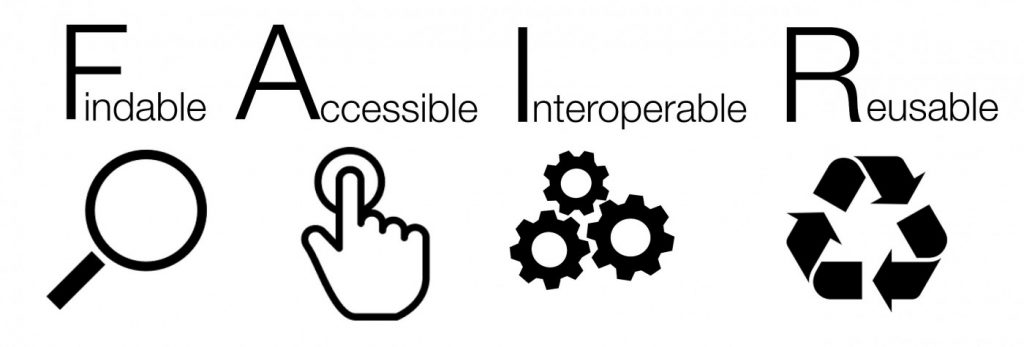
FAIR guiding principles for data resources (SanguaPundir 2016) CC-BY-SA
FAIR aims to improve the value and impact of research data by ensuring it is Findable, Accessible, Interoperable and Re-useable. All data produced by researchers at BU should be FAIR, and many journals and funders have made it a condition for successful submission or grant applications. Over a series of posts I will look at each one and explain what this means for the data you produce. Click here if you want to read the previous posts on Findability and Accessibility.
Interoperable
Researchers may well be able to find your data without restrictions (Findable, Accessible), but they may not be able to use your data if it is not available in a useable format. Imagine if valuable data was only available on a floppy disk… Not much use to most of us!
Data can be opened-up to more people if we make them available in open, interoperable formats. The UK Data Service has a list of recommended formats. Spreadsheets, for example, should be saved as .csv files. This is an open format, so users do not necessarily need a paid for solution like Microsoft Excel to open it.
For more information visit the Library’s Research Data Management guide or email bordar@bournemouth.ac.uk.
Dan Bailyes
Faculty Librarian (FMC) and LLS lead for Research Data Management (RDM)
References
SanguaPundir., 2016. FAIR guiding principles for data resources [image]. Wikimedia Commons. Available from: https://commons.wikimedia.org/wiki/File:FAIR_data_principles.jpg [Accessed 08 July 2021].







 NIHR Insight South West Central Conference 2026 at Bournemouth University
 BU PhD student presented at World Safety Conference in South Africa
 National Research Supervision Recognition: Apply Now & Join the Supporting Workshop on 16 September
 3C Event: ECR Network Café – Wednesday 16 September 2-3pm
 BU geography student’s undergraduate dissertation published in international journal
 Horizon Europe Cluster 3 (Civil Security for Society) 2026 Calls Now Open
 MSCA Doctoral Networks 2026 Call Information Webinar
 ESRC Festival of Social Science 2026: Application Deadline Extended to Thursday 25 June 2026
 Reminder: Register for the ESRC Festival of Social Science 2026 Information Session
 ECR Funding Open Call: Research Culture & Community Grant – Apply now
 ERC Advanced Grant 2025 Webinar
 Update on UKRO services
 European research project exploring use of ‘virtual twins’ to better manage metabolic associated fatty liver disease