BU-UHD 2nd Research Event – May 24-Invite for Abstracts
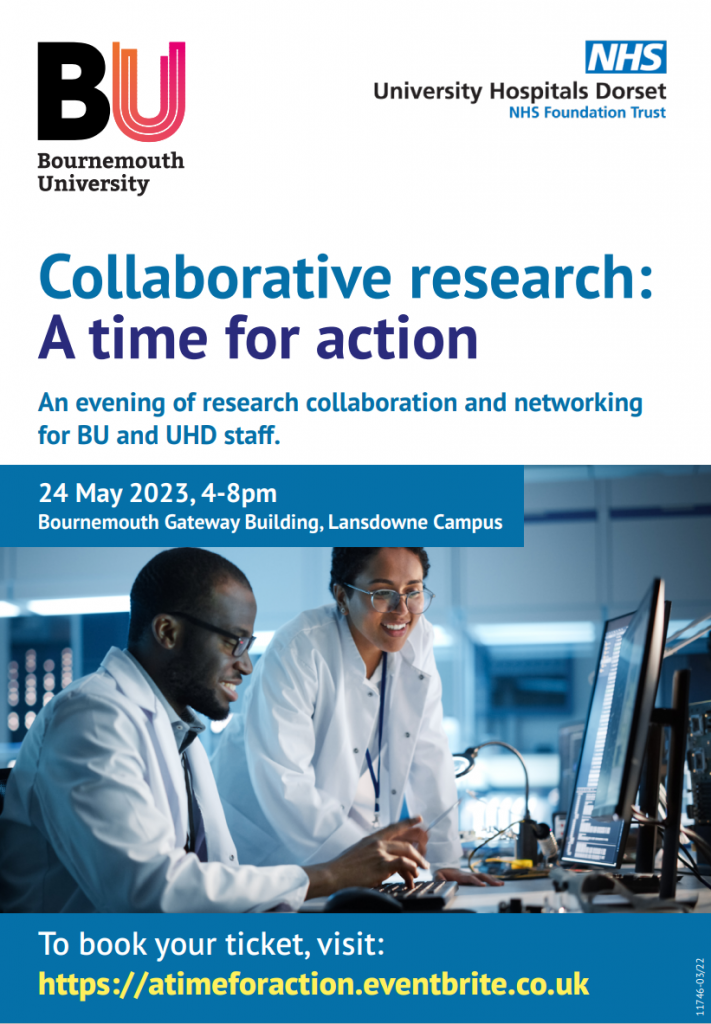 We are delighted to announce that bookings are now open for our 2nd research event: Collaborative Research: A Time For Action!
The BU-UHD partnership exists for the benefit of staff, students, patients, and the local community. This joint event will act as a catalyst for discussion around research collaboration and a perfect opportunity for networking.
To book your tickets, visit:https://atimeforaction.eventbrite.co.uk
The event starts with a keynote presentation from Professor William Rosenburg, newly appointed chair of Wessex Health Partners.
With facilitated discussions on developing future research in health inequalities; workforce and people; sustainable futures; digital futures and medical sciences this event is likely to be of interest to a wide range of BU and NHS staff.
Posters and presentations provide a chance to view and talk about collaborative research already underway.
Light refreshments will be served during the event.
Please, find the Abstract Submission form here: BU- UHD 2nd Research Event May 24 – Abstract Submission Form
All applications to be submitted to BU-UHD Research Steering Committee by 30 April 2023
 NIHR virtual event – Equality, diversity and inclusion in applied health and social care research
 We can help promote your public engagement event or activity







 Poverty in the UK: book launch today at BU
 BU contributions to successful Global Health conference
 New paramedic science paper by BU’s Dr. Ursula Rolfe
 Congratulation on newly published systematic review
 Horizon Europe Cluster 3 (Civil Security for Society) 2026 Calls Now Open
 MSCA Doctoral Networks 2026 Call Information Webinar
 ESRC Festival of Social Science 2026: Application Deadline Extended to Thursday 25 June 2026
 Reminder: Register for the ESRC Festival of Social Science 2026 Information Session
 ECR Funding Open Call: Research Culture & Community Grant – Apply now
 ERC Advanced Grant 2025 Webinar
 Update on UKRO services
 European research project exploring use of ‘virtual twins’ to better manage metabolic associated fatty liver disease