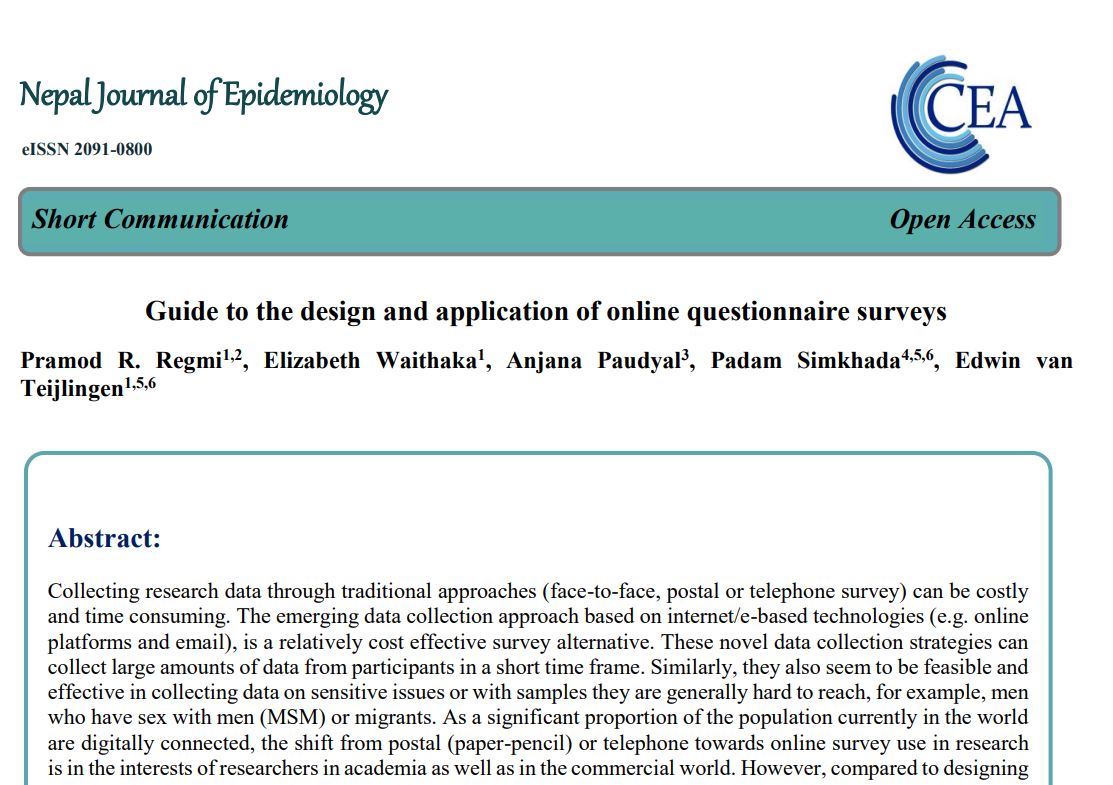
The paper ‘Guide to the design and application of online questionnaire surveys‘ [1] led by Dr. Pramod Regmi, Principal Academic in International Health in the Faculty of Health & Social Sciences, reached 200 citations today on ResearchGate. Our methods paper was published in 2016 in the Nepal Journal of Epidemiology which is Open Access, hence it is freely available to anyone in the world with internet access. 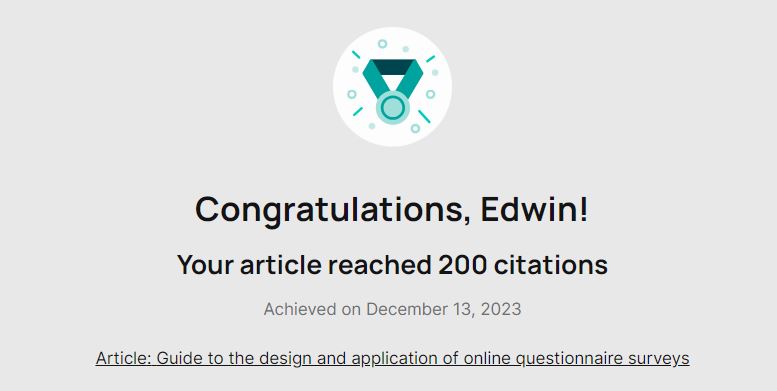
At the time conducting online surveys was still a bit of a novelty. In the paper we noted that there was limited literature to help a fledgling researcher with the design and a use of online questionnaires. Therefore, this short paper highlights issues around: a) methodological aspect of online questionnaire survey; b) online survey planning and management; and c) ethical concerns that may arise while using this option.
Prof. Edwin van Teijlingen
Centre for Midwifery & Women’s Health 
Reference:
- Regmi, P. R., Waithaka, E., Paudyal, A., Simkhada, P., & van Teijlingen, E. (2017). Guide to the design and application of online questionnaire surveys. Nepal Journal of Epidemiology, 6(4), 640–644.
 Congratulations to Prof. Bouchachia on latest paper
 Research methods paper published by CMMPH student Preeti Mahato
 Last BU paper of 2022







 Verbal autopsy paper published two days ago
 ESRC Studentships for 2027 Entry: Opportunity Now Open
 SONAMONI contributions to Safety Conference 2026 in South Africa
 Three CMWH presentations at Berlin conference
 Horizon Europe Cluster 3 (Civil Security for Society) 2026 Calls Now Open
 MSCA Doctoral Networks 2026 Call Information Webinar
 ESRC Festival of Social Science 2026: Application Deadline Extended to Thursday 25 June 2026
 Reminder: Register for the ESRC Festival of Social Science 2026 Information Session
 ECR Funding Open Call: Research Culture & Community Grant – Apply now
 ERC Advanced Grant 2025 Webinar
 Update on UKRO services
 European research project exploring use of ‘virtual twins’ to better manage metabolic associated fatty liver disease