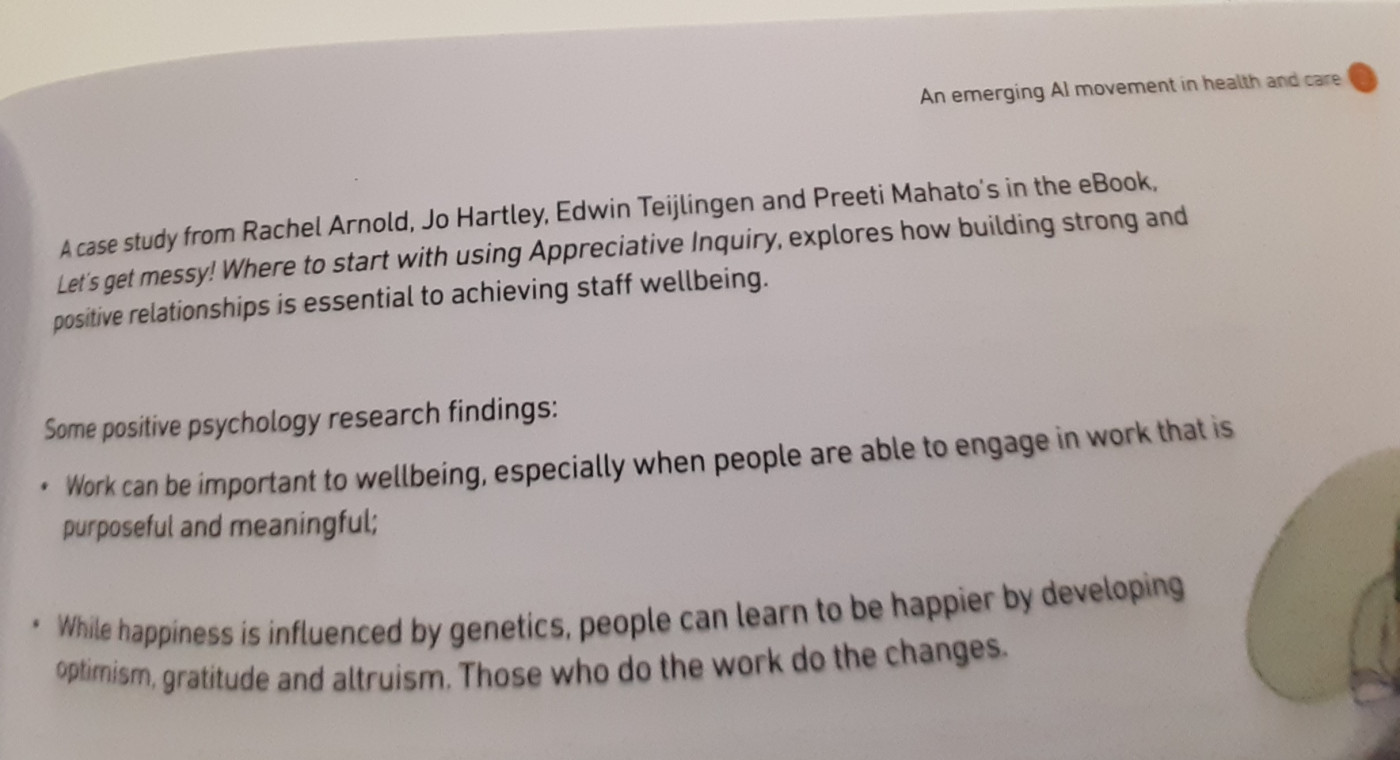
 Today we received a copy of the book Appreciating Health and Care in the post. This book has a sub-title ‘A practical appreciative inquiry resource for the health and social care sector’ and refers to the work led by Bournemouth University’s Dr. Rachel Arnold. Appreciative Inquiry values people’s expertise and vision and can motivate people to see the world differently and instigate positive change. Rachel been the lead author on several publications around Appreciative Inquiry [1-3].
Prof. Edwin van Teijlingen
Centre for Midwifery & Women’s Health (CMWH)
References:
- Arnold, R. (2024) Learning to use Appreciative Inquiry, i2Insights, 16th January.
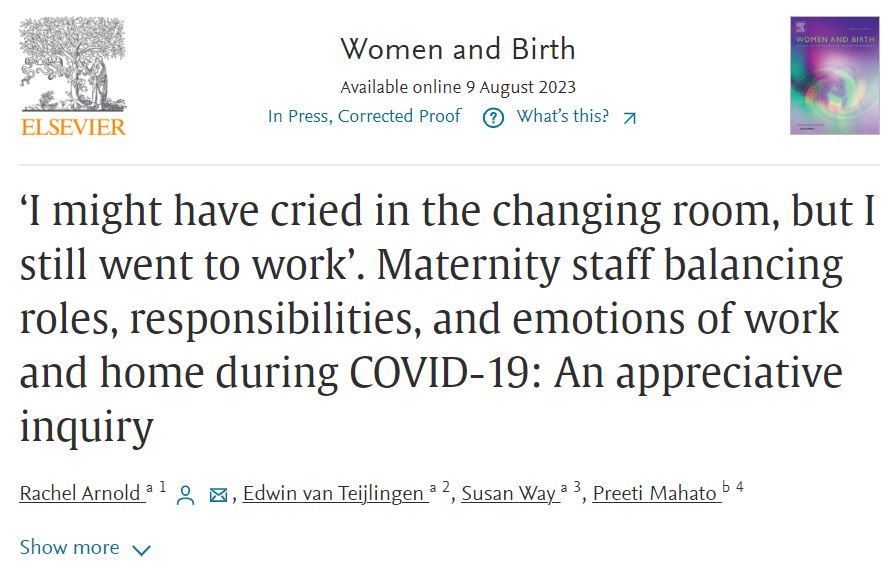
- Arnold, R., Way, S., Mahato, P., van Teijlingen, E. (2024) “I might have cried in the changing room, but I still went to work”. Maternity staff managing roles, responsibilities, and emotions of work and home during COVID-19: an Appreciative Inquiry, Women & Birth 37: 128-136.
- Arnold, R., Gordon, C., Way, S., Mahato, P., van Teijlingen, E. (2022) Why use Appreciative Inquiry? Lessons learned during COVID-19 in a UK maternity service, European Journal of Midwifery 6 (May): 1-7.
 An Appreciate Inquiry into NHS Maternity Services
 Congratulations to Dr. Rachel Arnold on her latest paper







 ECR Opportunities: New Development Programme, Researcher Grants & Upcoming Events
 Help us capture BU’s knowledge exchange activity HE-BCI survey 2025–26
 Verbal autopsy paper published two days ago
 ESRC Studentships for 2027 Entry: Opportunity Now Open
 SONAMONI contributions to Safety Conference 2026 in South Africa
 Horizon Europe Cluster 3 (Civil Security for Society) 2026 Calls Now Open
 MSCA Doctoral Networks 2026 Call Information Webinar
 ESRC Festival of Social Science 2026: Application Deadline Extended to Thursday 25 June 2026
 Reminder: Register for the ESRC Festival of Social Science 2026 Information Session
 ECR Funding Open Call: Research Culture & Community Grant – Apply now
 ERC Advanced Grant 2025 Webinar
 Update on UKRO services
 European research project exploring use of ‘virtual twins’ to better manage metabolic associated fatty liver disease