Congratulations to Dr. Louise Oliver and Orlanda Harvey on yesterday’s publication of ‘A Picture of Christian Grey: Using Narrative Analysis to Explore How Coercive Controlling Behaviors in Intimate Relationships Can Be Romanticized Within Fiction’ in the academic journal Humanities [1]. 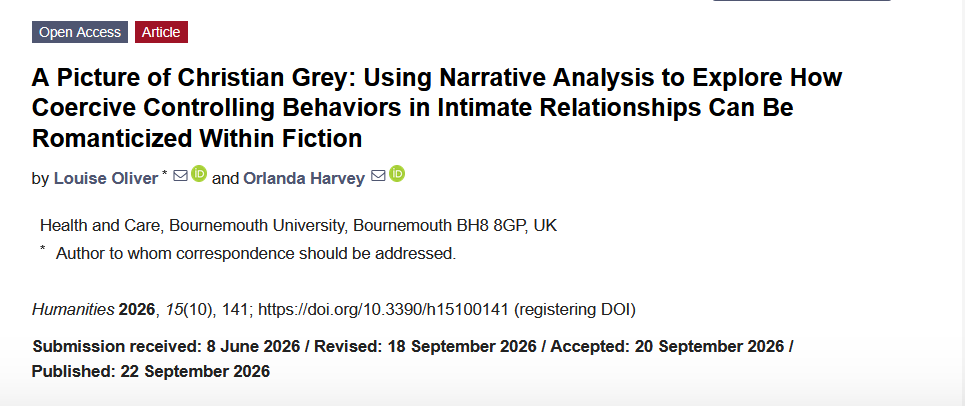 Intimate Partner Violence and Abuse (IPVA) is a public health phenomenon due to its prevalence and impact across the world.
The authors examine how coercive and controlling behaviors within intimate relationships are obfuscated, in other words, thrown into the shadows, romanticized, and normalized within romantic fiction, further adding to this global issue.  The “Fifty Shades of Grey” series is interpreted through the use of narrative analysis and the framework of Craven’s “Dominator” model. This illustrates how the distinct perpetrator personas, the Headworker, the Persuader, the King of the Castle, the Jailer, the Liar, the Bully, and the Sexual Controller, are present in the actions of the male protagonist throughout the series of books. This paper identifies how these books portray such behaviors that are used to coerce and control as desirable expressions of protection, masculinity, desire, and love. This paper, therefore, suggests that such texts contribute to the normalization of abusive relationships, embedding them within the cultural ideals of romantic love and, therefore, sustaining abusive relationships.
Well done!
Prof. Edwin van Teijlingen
Centre for Midwifery & Women’s Health
Reference:
- Oliver, L., & Harvey, O. (2026). A Picture of Christian Grey: Using Narrative Analysis to Explore How Coercive Controlling Behaviors in Intimate Relationships Can Be Romanticized Within Fiction, Humanities 15(10): 141. https://doi.org/10.3390/h15100141
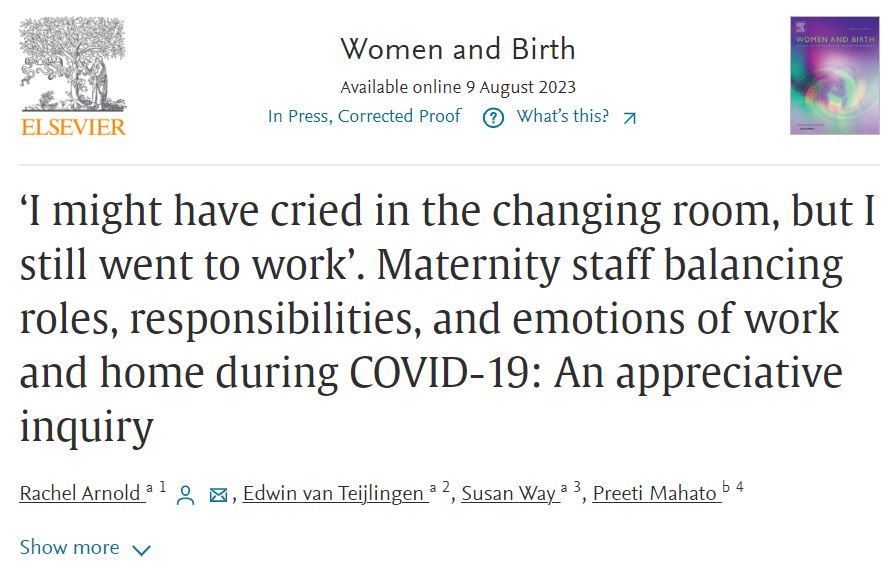







 Verbal autopsy paper published two days ago
 ESRC Studentships for 2027 Entry: Opportunity Now Open
 SONAMONI contributions to Safety Conference 2026 in South Africa
 Three CMWH presentations at Berlin conference
 Horizon Europe Cluster 3 (Civil Security for Society) 2026 Calls Now Open
 MSCA Doctoral Networks 2026 Call Information Webinar
 ESRC Festival of Social Science 2026: Application Deadline Extended to Thursday 25 June 2026
 Reminder: Register for the ESRC Festival of Social Science 2026 Information Session
 ECR Funding Open Call: Research Culture & Community Grant – Apply now
 ERC Advanced Grant 2025 Webinar
 Update on UKRO services
 European research project exploring use of ‘virtual twins’ to better manage metabolic associated fatty liver disease