A new paper in the leading archaeological journal Antiquity led by Dr Phil Riris of the Institute for the Modelling of Socio-Environmental Transitions reports on likely candidates for the world’s largest individual rock engravings, located along the Orinoco River. In collaboration with partners at the UCL Institute of Archaeology and Universidad de Los Andes (Colombia), the paper provides important new insights into how the pre-Columbian world was shaped by the beliefs of its peoples. The paper is available in Open Access: https://doi.org/10.15184/aqy.2024.55
Unlike geoglyphs (large artistic markings excavated into the soil), petroglyphs are engraved directly on rock faces. Producing them requires a great deal of effort. The engravings reported in the paper are several tens of metres on a side, with the largest engraving of a snake having an estimated length of 40 metres or more, pointing to a significant investments of time and energy in their creation.
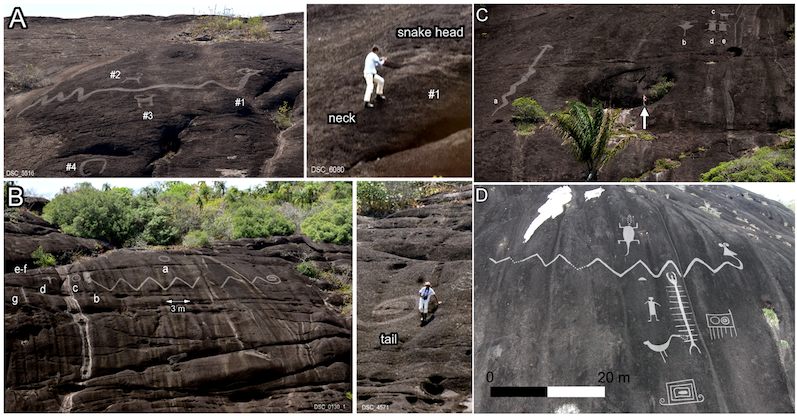
Some of the largest engravings of snakes reported in Colombia and Venezuela by the team. Images have been enhanced with a sketched overlay.
These “monumental” engravings include humans and animals resembling centipedes, deer, and birds, as well as large snakes such as boas or anacondas. They are typically located far up on hillsides overlooking stretches of the Orinoco river. They are thought to be related to marking territorial boundaries or appropriating new parts of the landscape during voyages, as they are regularly found along the river and its margins. Large “paintings” on hillsides are reported in the earliest missionary writings from the region, and may over time have become major landmarks in their own right.

Artistic impression of a giant snake swimming the Orinoco
It is vital that these monumental rock art sites are protected to ensure their preservation and continued study, with the Indigenous peoples of the Orinoco region central to this process.
The research was funded by the Leverhulme Trust, The Society of Antiquaries of London, Universidad de Los Andes, the Fundación de Investigaciones Arqueológicas Nacionales (Colombia), and the British Academy.
https://doi.org/10.15184/aqy.2024.55







 Geography and Environmental Studies academics – would you like to get more involved in preparing our next REF submission?
 Reminder: Recharge Your Research Routine Next Week for World Wellbeing Week
 Boost Your Research Toolkit: Digital Confidence & AI Literacy Workshop – Friday 26 June 10am-12pm
 BU students’ publishing success
 BU presentation at the University of Bristol
 Horizon Europe Cluster 3 (Civil Security for Society) 2026 Calls Now Open
 MSCA Doctoral Networks 2026 Call Information Webinar
 ESRC Festival of Social Science 2026: Application Deadline Extended to Thursday 25 June 2026
 Reminder: Register for the ESRC Festival of Social Science 2026 Information Session
 ECR Funding Open Call: Research Culture & Community Grant – Apply now
 ERC Advanced Grant 2025 Webinar
 Update on UKRO services
 European research project exploring use of ‘virtual twins’ to better manage metabolic associated fatty liver disease