An internationally significant and ground-breaking paper has appeared in the journal Nature, led by Dr Phil Riris of the Institute for the Modelling of Socio-Environmental Transitions.
The work investigates 30,000 years of population resilience, with contributions from collaborating scholars from 14 institutions in 7 countries. The paper marks a watershed in our understanding of how people in the past adapted to, and overcame, disturbances. It is available in open access.
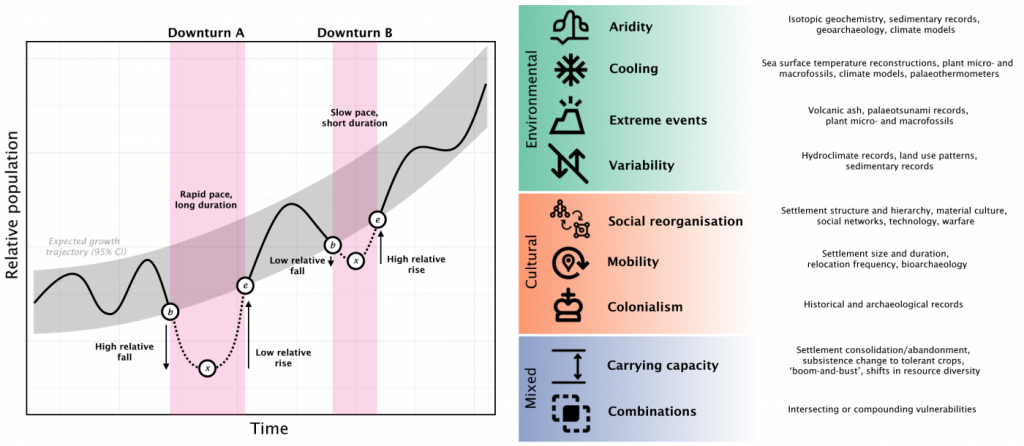
Left: A sketch of an archaeological population time series with downturns and metrics obtained during the analysis. Right: Example types and groups of disturbances noted in the literature.
The key finding of the paper is that land use – the kinds of subsistence practices, mobility regimes, and extent of infrastructure investments – enhanced both how often a population experienced downturns and their ability to recover from them. In particular, agricultural and agropastoral societies in prehistory were especially likely to suffer demographic busts. However, they also displayed an improved ability over time to “bounce back”.
This result has wide-ranging implications for the development of sustainable land use practices, as traditional lifeways may have intrinsic rates of failure “baked into” their function and operation. The paper speculates that, similar to resilient ecosystems or ecological communities, such localised, small-scale, or short-term failures in human socio-environmental systems may contribute to building improved long-term resilience for the system as a whole.
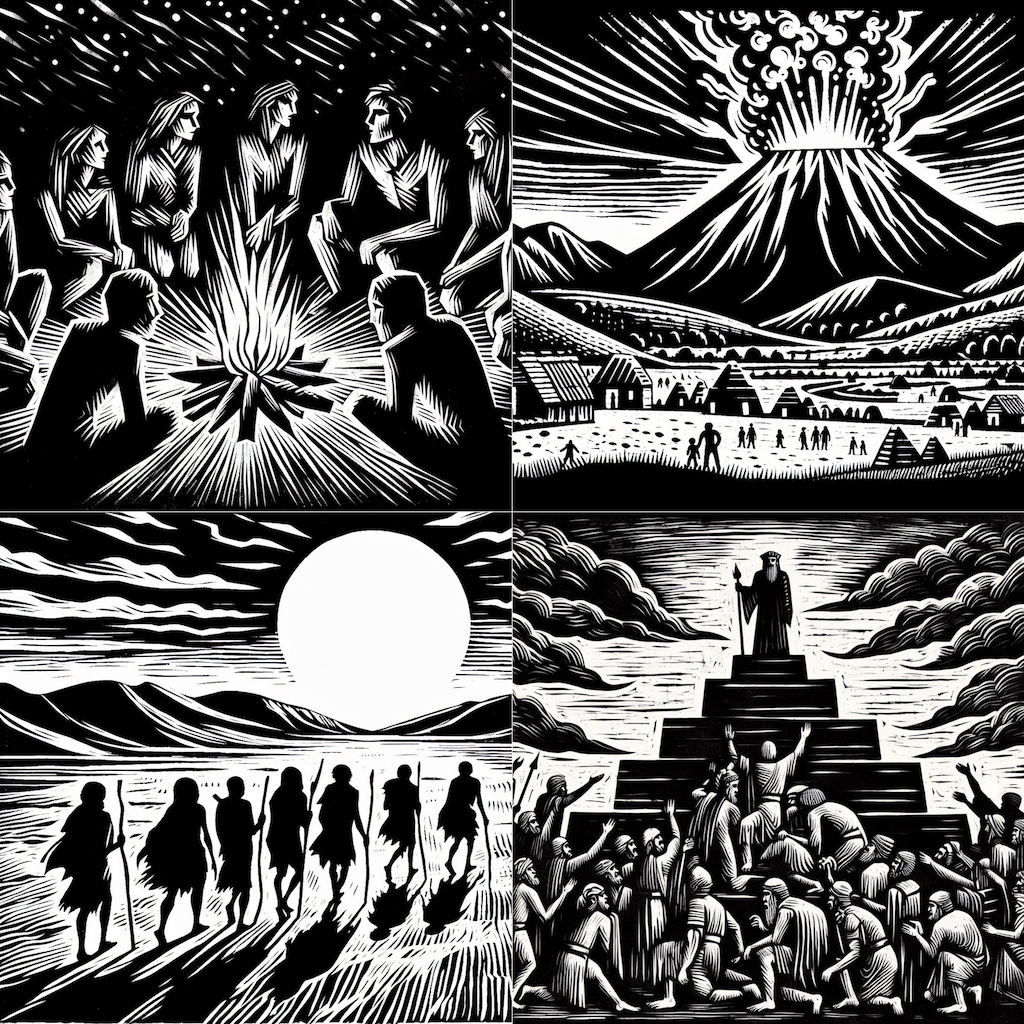
Artistic impression of some of the types of disturbances experienced by ancient societies.
Importantly, these patterns only reveal themselves in the macro-scale comparison of independent case studies, and take multiple decades or even centuries to unfold. Archaeology is the only field able to tackle these timescales systematically, and underscores the value and contribution of the historical sciences to resilience-building and sustainability challenges in the present.
URL: https://www.nature.com/articles/s41586-024-07354-8
The research was funded by the Arts and Humanities Research Council (AH/X002217/1).







 Verbal autopsy paper published two days ago
 ESRC Studentships for 2027 Entry: Opportunity Now Open
 SONAMONI contributions to Safety Conference 2026 in South Africa
 Three CMWH presentations at Berlin conference
 Horizon Europe Cluster 3 (Civil Security for Society) 2026 Calls Now Open
 MSCA Doctoral Networks 2026 Call Information Webinar
 ESRC Festival of Social Science 2026: Application Deadline Extended to Thursday 25 June 2026
 Reminder: Register for the ESRC Festival of Social Science 2026 Information Session
 ECR Funding Open Call: Research Culture & Community Grant – Apply now
 ERC Advanced Grant 2025 Webinar
 Update on UKRO services
 European research project exploring use of ‘virtual twins’ to better manage metabolic associated fatty liver disease
Congratulations on this finding and paper!