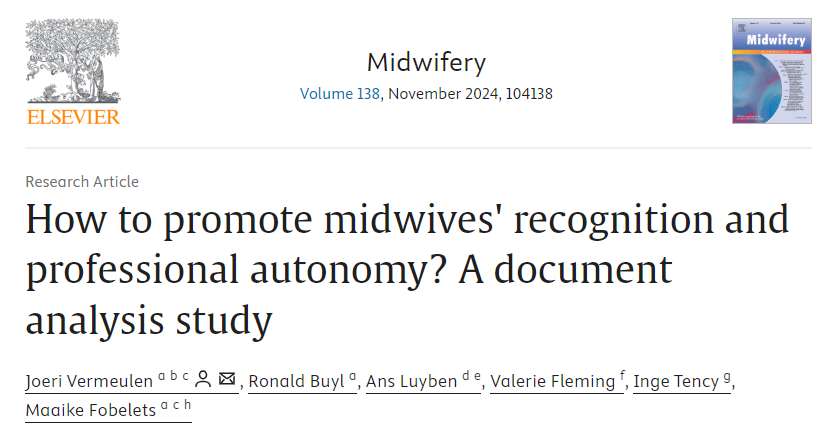
 Congratulations to Dr. Ans Luyben on the publication of her latest midwifery article ‘How to promote midwives’ recognition and professional autonomy? A document analysis study’ [1]. This latest paper will appear in the forthcoming November issue of the international scientific journal Midwifery, published by Elsevier.
 The paper identified challenges in Belgian midwives’ recognition and professional autonomy and provided recommendations to address them, emphasizing the importance of recognized authority in midwifery. Implementing these recommendations can positively impact midwives’ recognition and autonomy in Belgium as well as in other countries. Ans has long been affiliated with the Centre of Midwifery & Women’s Health (CMWH) as Visiting Faculty and she works in the Frauenzentrum (Centre for Women’s Health), Lindenhofgruppe, Bern, Switzerland.
Well done!
Prof. Edwin van Teijlingen
Reference:
- Vermeulen, J., Buyl, R., Luyben, A., Fleming, V., Tency, I., Fobelets, M. (2024) How to promote midwives’ recognition and professional autonomy? A document analysis study Midwifery, 138: 104138.
 Midwifery paper read 2,500 times
 New collaborative publication FHSS PhD students, staff & Visiting Faculty







 SONAMONI contributions to Safety Conference 2026 in South Africa
 Three CMWH presentations at Berlin conference
 New interdisciplinary paper on Nepal
 Horizon Europe Cluster 3 (Civil Security for Society) 2026 Calls Now Open
 MSCA Doctoral Networks 2026 Call Information Webinar
 ESRC Festival of Social Science 2026: Application Deadline Extended to Thursday 25 June 2026
 Reminder: Register for the ESRC Festival of Social Science 2026 Information Session
 ECR Funding Open Call: Research Culture & Community Grant – Apply now
 ERC Advanced Grant 2025 Webinar
 Update on UKRO services
 European research project exploring use of ‘virtual twins’ to better manage metabolic associated fatty liver disease