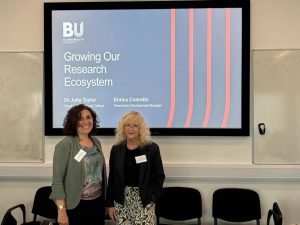
Last week, we had the opportunity to present our Research Culture and Community Grant at the UKCGE Annual Conference. Our session, Growing Our Research Ecosystem, was centred on a simple but important idea: some of the most meaningful aspects of research culture happen outside formal structures. Introduced by the Doctoral College 3 years ago, the Research Culture and Community Grant empowered researchers to design and lead initiatives that mattered to them and their communities.
Preparing for the conference gave us the opportunity to revisit many of the projects we have supported over the last years. While the funded projects were very different from one another, they shared something important: they created spaces where researchers could connect as people as well as academics, bringing different perspectives, experiences and cultures into the research environment.
As we discussed at the conference, these are often the spaces where belonging develops. They help researchers feel visible, valued and connected, particularly those who may otherwise feel marginalised or isolated within academic environments.
Role shift for researcher developers?
The grant promotes co-creation mechanisms, shifting from provider-led to researcher-led development. What we have learned through this initiative is the value of becoming enablers rather than providers. Our role is not always to create the activity ourselves; sometimes it is to create the conditions that allow researchers to build communities, initiate conversations and shape research culture in ways we could never fully anticipate.
The success of these initiatives suggests that when granted autonomy and resources, researchers construct alternative spaces for connections — spaces that often complement or exceed the scope of the usual development programme offered at institutional level.
Continuing to grow our research ecosystem
The growth of the grant scheme, from 13 funded PGR projects in 2024–25 to 17 PGR projects and 10 ECR projects in 2025–26, demonstrates both demand and enthusiasm for this approach. But more importantly, it highlights the willingness of our researchers to contribute positively to their communities, when given the opportunity to do so.
Growing a thriving research ecosystem is not always about creating bigger programmes or larger interventions. Sometimes it starts with listening carefully, identifying hidden communities, and providing people with the trust, autonomy and support they need to flourish.
Dr Julia Taylor, Head of the Doctoral College, and Enrica Conrotto, Researcher Development Manager
 Reflections on the 13th Postgraduate Research Conference
 Reflections on the 14th Annual Postgraduate Research Conference







 BU methods paper reached 2,500 reads
 UKCGE Recognised Research Supervision Programme: Applications Close 19 October
 Dr. Orlanda Harvey interviewed as expert
 Dr. Paul Whittington attends Technology and the SEND Reforms Roundtable in the House of Commons
 Dr. Paul Whittington joins Bett 2026 DfE Assistive Technology Roundtable
 BU Prof Jonathan Parker promoting social work in Malaysia
 Horizon Europe Cluster 3 (Civil Security for Society) 2026 Calls Now Open
 MSCA Doctoral Networks 2026 Call Information Webinar
 ESRC Festival of Social Science 2026: Application Deadline Extended to Thursday 25 June 2026
 Reminder: Register for the ESRC Festival of Social Science 2026 Information Session
 ECR Funding Open Call: Research Culture & Community Grant – Apply now
 ERC Advanced Grant 2025 Webinar
 Update on UKRO services
 European research project exploring use of ‘virtual twins’ to better manage metabolic associated fatty liver disease