According to Google Scholar, the tool will ‘use a statistical model based on author names, bibliographic data, and article content to group articles likely written by the same author’. You can then identify your articles using these groups and Google Scholar will then automatically produce the citation metrics. Three metrics will be available: the h-index, the i-10 index (which is the number of articles with at least ten citations), and the total number of citations to your articles. Each of these metrics will be available for all outputs as well as for articles published in the last five years, and will be automatically updated as new citations are available on the web.
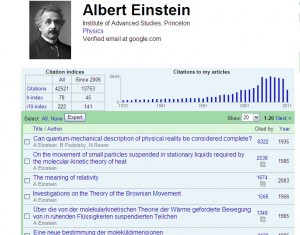 You will be able to update your ‘profile’ of outputs by adding missing items, merging duplicates or correcting bibliographic errors. You’ll also have the choice to make your profile public, the idea being that you’ll make it easier for colleagues globally to follow your research because your outputs will appear in Google Scholar search results.
To get a glimpse of Google Scholar Citations in action, there are some sample profiles available via the Google Scholar blog. You can also register your email address so that you will be notified when the tool is finally available to everyone.







 Verbal autopsy paper published two days ago
 ESRC Studentships for 2027 Entry: Opportunity Now Open
 SONAMONI contributions to Safety Conference 2026 in South Africa
 Three CMWH presentations at Berlin conference
 Horizon Europe Cluster 3 (Civil Security for Society) 2026 Calls Now Open
 MSCA Doctoral Networks 2026 Call Information Webinar
 ESRC Festival of Social Science 2026: Application Deadline Extended to Thursday 25 June 2026
 Reminder: Register for the ESRC Festival of Social Science 2026 Information Session
 ECR Funding Open Call: Research Culture & Community Grant – Apply now
 ERC Advanced Grant 2025 Webinar
 Update on UKRO services
 European research project exploring use of ‘virtual twins’ to better manage metabolic associated fatty liver disease
I have a publications page that lists my publications (see my Imperial College London Publications page). I find the extra functionality available in Google Scholar Citations very useful. The ability to view citation metrics is helpful, as are the charts the service can produce.