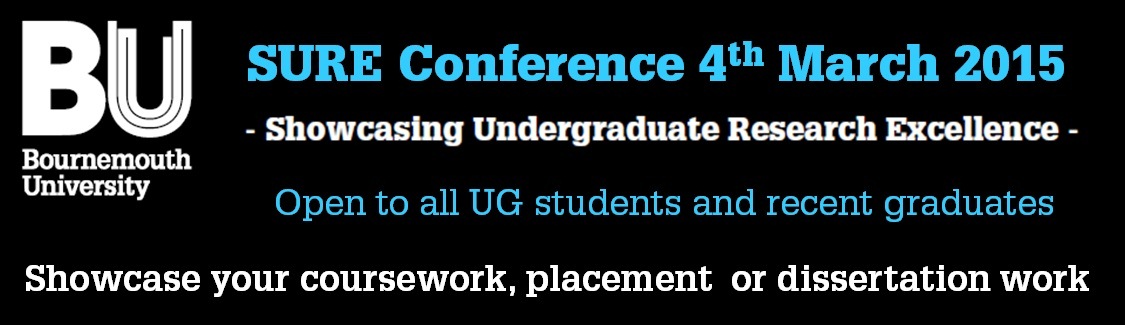
Competition open to all BU undergraduate students and recent graduates
Research skills are central part of all undergraduate and postgraduate studies, and are also a key skill in most career paths. On March 4th 2015, Bournemouth University will be hosting a conference to showcase the best examples of research work from BU’s current undergraduates and recent graduates. As well as having the opportunity to present their research and develop new skills for their CVs, students will also have the chance to win prizes such as a fully funded MSc or MRes at BU, a paid placement and vouchers.
Students and recent graduates are now being invited to submit their applications by the deadline of 20th January. Abstracts should be no longer than 300 words, and could describe a broad range of research activities, such as a dissertation, essay, work for a placement, volunteering or even research undertaken for a student society. The main criteria is that students are able to demonstrate their own critical thinking. All BU undergraduates – from all courses and faculties – as well as recent graduates are eligible to apply.
To submit your 300 word abstract, register here.
Terms and conditions for the competition can be viewed here.
 Bournemouth University student wins ‘Best Undergraduate Research Paper Award’
 Prestigious undergraduate research conference comes to Bournemouth
 British Conference of Undergraduate Research – encouraging students to apply







 REF 2029 Sector Survey: Have Your Say
 BU methods paper reached 2,500 reads
 UKCGE Recognised Research Supervision Programme: Applications Close 19 October
 Dr. Orlanda Harvey interviewed as expert
 Dr. Paul Whittington attends Technology and the SEND Reforms Roundtable in the House of Commons
 Dr. Paul Whittington joins Bett 2026 DfE Assistive Technology Roundtable
 Horizon Europe Cluster 3 (Civil Security for Society) 2026 Calls Now Open
 MSCA Doctoral Networks 2026 Call Information Webinar
 ESRC Festival of Social Science 2026: Application Deadline Extended to Thursday 25 June 2026
 Reminder: Register for the ESRC Festival of Social Science 2026 Information Session
 ECR Funding Open Call: Research Culture & Community Grant – Apply now
 ERC Advanced Grant 2025 Webinar
 Update on UKRO services
 European research project exploring use of ‘virtual twins’ to better manage metabolic associated fatty liver disease