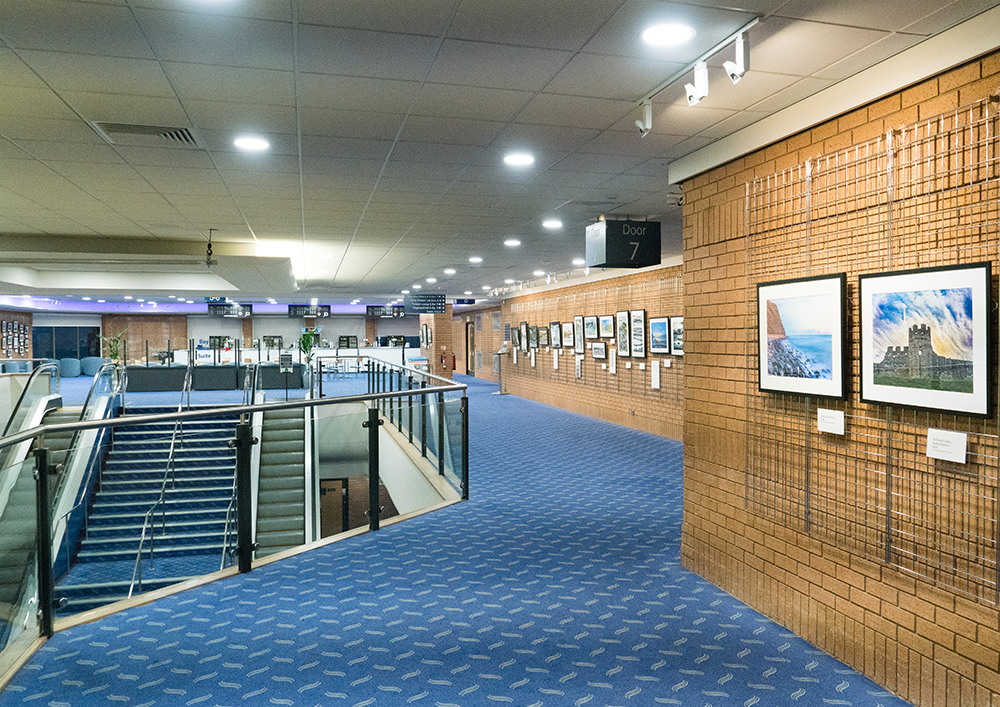
‘LandEscapes – Treading on the line of fantasy and realism’ – A high dynamic range landscape photography exhibition at the Bournemouth International Centre
Our next instalment of the ‘Photo of the Week’ series features Rehan Zia’s exhibition ‘LandEscapes- Treading on the line of fantasy and realism’. The series is a weekly instalment, which features an image taken by our fantastic BU staff and students. The photos give a glimpse into some of the fascinating work our researchers have been doing across BU and the wider community.
“My practice-led research is looking at exploring the best practice in high dynamic range landscape photography. I often exhibit images that I have created to acquire feedback that I could subsequently reflect upon. This image shows my latest and biggest exhibition ‘ LandEscapes – Treading on the line of fantasy and realism’ at the Bournemouth International Centre (BIC) where 35 of my images were on display from 6 December 2016 – 12 January 2017,” explains Rehan.
If you’d like find out more about the research or the photo itself then please contact Rehan.
This photo was originally entry to the 2017 Research Photography Competition. If you have any other questions about the Photo of the Week series or the competition please email research@bournemouth.ac.uk
 Photo of the Week: Birthing centre in Nawalparasi, rural Nepal
 Photo of the Week: Dramaturgical study of ‘Game of Thrones’







 National Postdoc Appreciation Week 2026: The Changing Landscape of Postdoc Careers
 NIHR Insight South West Central Conference 2026 at Bournemouth University
 BU PhD student presented at World Safety Conference in South Africa
 National Research Supervision Recognition: Apply Now & Join the Supporting Workshop on 16 September
 Horizon Europe Cluster 3 (Civil Security for Society) 2026 Calls Now Open
 MSCA Doctoral Networks 2026 Call Information Webinar
 ESRC Festival of Social Science 2026: Application Deadline Extended to Thursday 25 June 2026
 Reminder: Register for the ESRC Festival of Social Science 2026 Information Session
 ECR Funding Open Call: Research Culture & Community Grant – Apply now
 ERC Advanced Grant 2025 Webinar
 Update on UKRO services
 European research project exploring use of ‘virtual twins’ to better manage metabolic associated fatty liver disease